Monday, 11 June 2012

Weekend: Demonstrations (我們都是李旺陽)

Demonstrations in Hong Kong are one of the most common means of expressing a message within the local political scene. They are different from demonstrations in many other countries; in the sense that in this city, they are perceived as being incredibly peaceful and orderly. Despite this image being challenged given the [understandable and oft misconstrued portrayals of*] conflicts with police in recent years, demonstrations remain almost a weekly affair, but they tend to be of small-to-moderate scale (a turn-out of around a hundred to a thousand people), and of specific scope in their demands. This plethora of protests is thanks to the fragmented political and social scene in Hong Kong, where individual groups voice their own interests which may exclude and alienate the sympathies of others. This is pretty consistent throughout the year, save for large-scale happenings such as the candlelight vigil of the 4th of June and the annually-expected 1st of July protests. 


But there are occasionally events that occur which temporarily puts aside the differences of many political parties (sans DAB. Always sans DAB.) and draws large numbers of people onto the streets; in this instance, the 'suicide' of activist Li WangYang who was imprisoned in the mainland for two decades and was found dead under suspicious circumstances.


As if the suicide wasn't dodgy enough as it is, sentiments of anger precipitated in Hong Kong after the CCP issued a series of answers and explanations that did not....answer or explain anything. (Avoiding the jokes that Hong Kong people watch way too much CSI to be easily accepting of the obscured conditions of Li's death, even foreign tourists in Wan Chai said that there was no way Li could have killed himself based on the scant imagery that has been circulating online. The international community knows...) The obvious questions have been circulating in the media and social networks; why would a man with no intention for suicide suddenly take his own life? Where would he even get the rope to hang himself? How does a visually-impaired person with limited mobility manage such a feat anyways, especially since it could be assumed that he was under the watch of CCP officials since his release from prison? These questions aren't the most ire-invoking matter; it is the CCP's contradictory practice. Promising an open inquiry but immediately cremating the body of Li, and monopolizing access to the surveillance recordings to Li's room. Cutting off contact between friends of the Li family, and those who promised to aid in their search for truth. (Check out the Wall Street Journal blog for a more fleshed-out account on the happenings.)


Hong Kong people don't have the answers, and any ideas offered will remain speculation. But they can demand for transparency and for the facts to be made clear; they can show their horror at the maltreatment of activists in the mainland; they can pay their respects to the man who fought for the recognition of the killings on the 4th of June 1989. And so this weekend, the inhabitants of this city made their feelings towards this matter be known, and took to the streets under the theme of  '我們都是李旺陽' (translates to 'We are also Li WangYang'. Over a dozen organizations and parties banded together for the demonstration; I opted to partake with Art Citizens, a group formed by local artists and people concerned with the arts. (They debuted last year in the protest calling for the freedom of Ai Wei Wei, and also on the 1st of July 2011 against police demands for no music to be played during the annual protest.) Check out the photos:

Starting from East Point Road in Causeway Bay 

White shirts, white banners, white flowers; a funeral procession 

Blindfolded and waving banners with poems written on them

People from the group marching behind Art Citizens. It was a hot day, and there were many standstills during the march, so it very tiring

During one of the longer standstills just before reaching the Beijing liaison offices. The entire street was packed (can't see all of the people in this photo because many of them were around the corner where the main road was), and I'm pretty sure that the police estimate of 5,400 attendees is fairly off.    


I think underlying this demonstration calling for transparency in Li's death, are deeper concerns within the Hong Kong psyche. What is the worth of a human life to the CCP these days? What is the worth of a human life to us? Can we live our lives quietly and in a docile manner knowing that the CCP has not been held accountable for their actions towards activists in China? How long will it take before the CCP will acknowledge 1989, and how long till the democratic ideals from 1989 realize itself into Hong Kong? Will the imprisonment and mistreatment of activists in the mainland be a glimpse of what is to come in Hong Kong? Can we move away from being a city only concerned with economic development and towards being one guided by a sense of morality?


-----------------------------------


*the idea of 'disorderly protesters' who 'instigate' and 'provoke' conflict is a dangerous myth. It needs not mentioning the issue of media bias, selective reporting, and the recognition of the media as a corporation out to sell a story using the most eye-catching images. You do have a tiny number of people in the crowds who are egging for trouble with the police, and they are responsible for their own actions. But if you have been near that situation the first thing that happens is that fellow protesters will talk the individuals involved down from open conflict. 


Sometimes (or better to say oftentimes) it is the Hong Kong police that overreacts, leading to scuffles; they say that protesters are 'violent' and pepper-spray them, but what is this 'violence' they speak of? Shaking a few police barricades? Trying to resist against the oft-unreasonable restrictions imposed by police to the demonstrations route? The definition of 'violence' employed by the Hong Kong police has a pretty low threshold, especially when you compare with the 'violence' that occurs around the world. (And looking back at the debacle of the HKU 100 celebrations, where police confined students in the campus stairwell, what was the supposed offence of the affected students? The simple act of shouting for democracy on campus grounds during the mainland vice-premier's visit.) 


Not saying that the Hong Kong police should be painted in an antagonistic role; many them do try to be helpful, keeping protesters away from passing traffic and keeping in communication with the protest organizers to ensure that things are going along as planned for both sides. (And I won't even hazard a guess into the sort of conflicts they go through trying to juggle what their jobs demand and wheretheir personal sympathies lie.) But then you have police officers doing this sort of thing: check out this video on youtube showing how a police officer grabbed the head of a youth protester who was turned away. Completely unwarranted, unjustifiable, and unfortunately for the sake of all, unnoticed in the mainstream for now. For a police force that is so against 'violent measures', they sure don't have an issue employing it for their use. 

Thursday, 7 June 2012

Musings: the Seeds of Creativity

Just a quick sketch that is loosely based on the happenings in Hong Kong these days, especially the issue of the government trying to push for a copyright law this July, in the interest of 'protecting creative property'.


Hong Kong does need some form of a copyright law, I have no issue admitting to this. But not one that is poorly drafted, poorly explained, and offers no clear delineation as to the material it covers. (And always be in doubt of a proposed law when the government resorts to the sales pitch of "pass the law now, we'll sort through the details later.")


Although not explicitly mention by the government (then again, when does the HK government ever issue a fully transparent statement?) one can't help but feel as though this law is an attempt to muffle one important avenue of political expression in this city; that of parody. Parody (known as 惡搞) is a way for it's users to attain the ability to voice out a critical-- and oft opposing-- viewpoint towards something purported by the mainstream and/or the authorities. The key elements of this involves humour and a degree of abstract representation of the issues at hand, which makes it easy to 'consume' for the wider public (as opposed to providing a hardline statement which may turn people away. A very likely case in Hong Kong), and offers a degree of protection from persecution as long as all references remain indirect. (Think of the role of parody as akin to the court jester of the medieval courts. It may be appear as a trivial role of entertainment, but jesters are protected from whatever they say due to their status as a bearer of humour. Thus these jesters are vital when it comes to conveying news that may not be savory for those who listen-- for example the 14th century French royal court heard about their defeat in a naval battle with the English after the jester hinted at their loss through a joke. No other official dared to speak up lest they incur the wrath of the royals-- and were an important mouthpiece for the difficult-to-stomach truths.)


So just how rampant is parody in Hong Kong, and what form do parodic works take? Unsurprisingly, given the proliferation of the Internet in most Hong Kong homes, it is mostly online. And thanks to social networks, it is easily spread to a mass audience, and most works are well receive by them. There are a lot of popular culture references (possibly due to the age of the parodic work maker and the destined audience), some of the most popular being movie posters from local Hong Kong cinema and Hollywood. A fantastic example emerged a month or so ago, when the faces of The Avengers poster was replaced with those of unpopular government officials (the lineup includes Fan, Leung, Lam, etc.) under the aptly renamed team of The Suppressors. Another great poster had the face of Tang superimposed on the poster for The Iron Lady with a caption for 'selling the wife' (a pun that makes sense in the Chinese version of the poster), a response to Tang's wife facing the media for the illegal basement structure debacle. And then there are the numerous versions of Leung's face being superimposed on chairman Mao's propaganda posters, alluding to Leung's ties with the communist party...


But the ability to link an issue at hand, and the people involved, to another piece of existing work that allows for a comedic representation of all these elements is a skill in itself. Can one not say that this process of visual articulation is in itself a valid form of creativity? And if so, does this not render moot the need to combat parodic works under the guise of 'protecting creative property'? (So where does the the justification of a copyright law lie? That the makers of parodic works don't give credit to the creators of the original piece? Would issuing a disclaimer/attributing credit resolve such an issue? And to what extent will the parodic work have to differ from the original material to avoid such a necessity, in the sense that the parodic work becomes something 'new' in its own right?)


But asides from speculating what this law will do to the parody scene, the notion of 'creativity' in itself needs to be examined. The argument in support for the law proposed by the government is lacks an understanding of the issues of 'creativity'. As pointed out in June's edition of CUP magazine (check out pages 65-67), even works of seeming originality can trace its 'inspiration' from an older work. Has there ever been something such as 'pure originality', something that makes no reference from another work and emerged in its own totality? Is this feat even possible, given how most individuals of this society are bound to be exposed to the works of others on a conscious and unconscious level? How do we, and how should we, understand and define 'creativity' at all?


I think, the problem is in how we determine whether the link between two pieces of work is that of acceptable 'inspiration' or that of exploitative 'plagiarism*'. (Plagiarism within writing and academic work is easy to define and identify. Same goes for evident plagiarism such brand-name knock-offs you see in Fa Yuen Street. In these examples there is a direct one-to-one replication of the traits embodied by the original, and a matter of personal gain. The problem is the application of this term to works that make a reference to another in a manner of 'allusion'.) Is there a spectrum in which to measure whether a piece or work fluctuates from one label to the other? I'm not sure what the criteria for judgement is, but it is certain that this is not something that should be determined by the government.


So leave parody alone, Hong Kong government. And do what you do best; continue to supply people with abundant material to continue the making of parodic works.


-----------------------------------


*I also find plagiarism to be problematic from a cultural standpoint. In some Asian societies (also applicable to the old painting masters of Europe), the art tradition is passed through a process of copying, reproducing, imitating existing work as a means to refine and hone skill sets. It was/is considered a legitimate means of propagating the art discipline. And imitation itself can be considered to be a form of flattery and a show of appreciation in certain contexts. In present day Japan, you have fanart being sent to authors of popular manga and anime works, with some authors thanking their fans and even publishing such works for public viewing. Doujinshi (a fan-made manga volume) may sometimes appropriate the characters of another piece of work for use in a different setting, but there seems to be little qualms about this issue.


Monday, 4 June 2012

Event: 這一代的六四

For the older generations in Hong Kong who witnessed June 4th 1989 through real-time feed from the media, it leaves an emotive memory even twenty three years later. But for the younger generations, such as those born in the 1970s, 1980s, and 1990s, what does June 4th mean for them? Children of these three decades were too young-- and perhaps not even born yet-- to have had the emotional and memory capacity to remember and feel the implications of 1989.


only learning about it through oral narratives from older family members, the calls from democratic political parties (don't be fooled by the Democratic Alliance for the Betterment of Hong Kong, the DAB, despite them having the word 'Democratic' in their name. They are incredibly pro-Beijing, and in 2007 their ex-chairman Ma Lik tried to play down the killings that took place in Tiananmen), the media, and from the internet. Unlike in mainland China, the term '六四' (Chinese for June 4th) is not taboo, nor risky to use in the face of authorities; one could say that the current youths grew up alongside this term, and thus June 4th is cemented within the youth psyche. 

But what exactly does June 4th mean for youths? Without bearing direct witness and only relying on secondary sources, can the meanings from 1989 transcend into the present day? Or is it even important to keep the same meaning from the past; can the youths of today's Hong Kong create their own connection towards June 4th? (And is it enough to just be aware of the killings, and not to engage with it?)

This is what some Hong Kong youths try to address; one such effort manifests as an art performance on the streets of Causeway Bay, known as 這一代的六四. (Having to use the phrase 'art performance' as a way of describing it shows the limitations of the English language. The word 'performance' denotes a show meant for an audience, and contains a degree of entertainment value. The Chinese phrase used is '街頭藝術活動' which can be roughly translated to 'action of art' on the streets.) This is its third year in the running, where a group of youths (and some non-youths with a youthful spirit) with and without art training will stand on the street for two hours expressing their views and understanding of June 4th. There are a range of different art practices at play; performative art, contemporary dance, choir song, poetry reading, and paintings placed on the roadside for view. 

Some displays leaned towards the literal (harkening to the imagery of the Tiananmen tanks), others more abstract. Some worked together in groups, others alone. Some appeared to be a commentary on the killings and repression of 1989, others touching upon a more personal narrative. Some spoke of Beijing, others transcended the matter of site and focused on the practices of the Hong Kong mentality. Check out some photos:


People who encountered this performance may not necessarily understand or interpret what is going on (nor will I profess to have encompassing insight about all of it either), but then it seems superficial to assume that the various happenings of the night is only devoted to the entertainment or gratification of the passing public. (And so leads to a much bigger issue of about the nature of art itself, and the state of art education in Hong Kong...topics that I'm nowhere near qualified to ramble on about.) 


The street performance shouldn't be construed as a separate way of remembering June 4th, breaking away from the annual candlelight vigil at Victoria Park organized by formalized organizations, institutions, and political parties; many of the performers will also take part in that as well (this art event took place on the 3rd of June, so that there will be no clashes.) You could call it a supplement to the more 'mainstream' ways of remembering 1989, allowing a new avenue to explore and interact with this bit of unresolved history. 


Sunday, 3 June 2012

People: Mr. Henry Wong

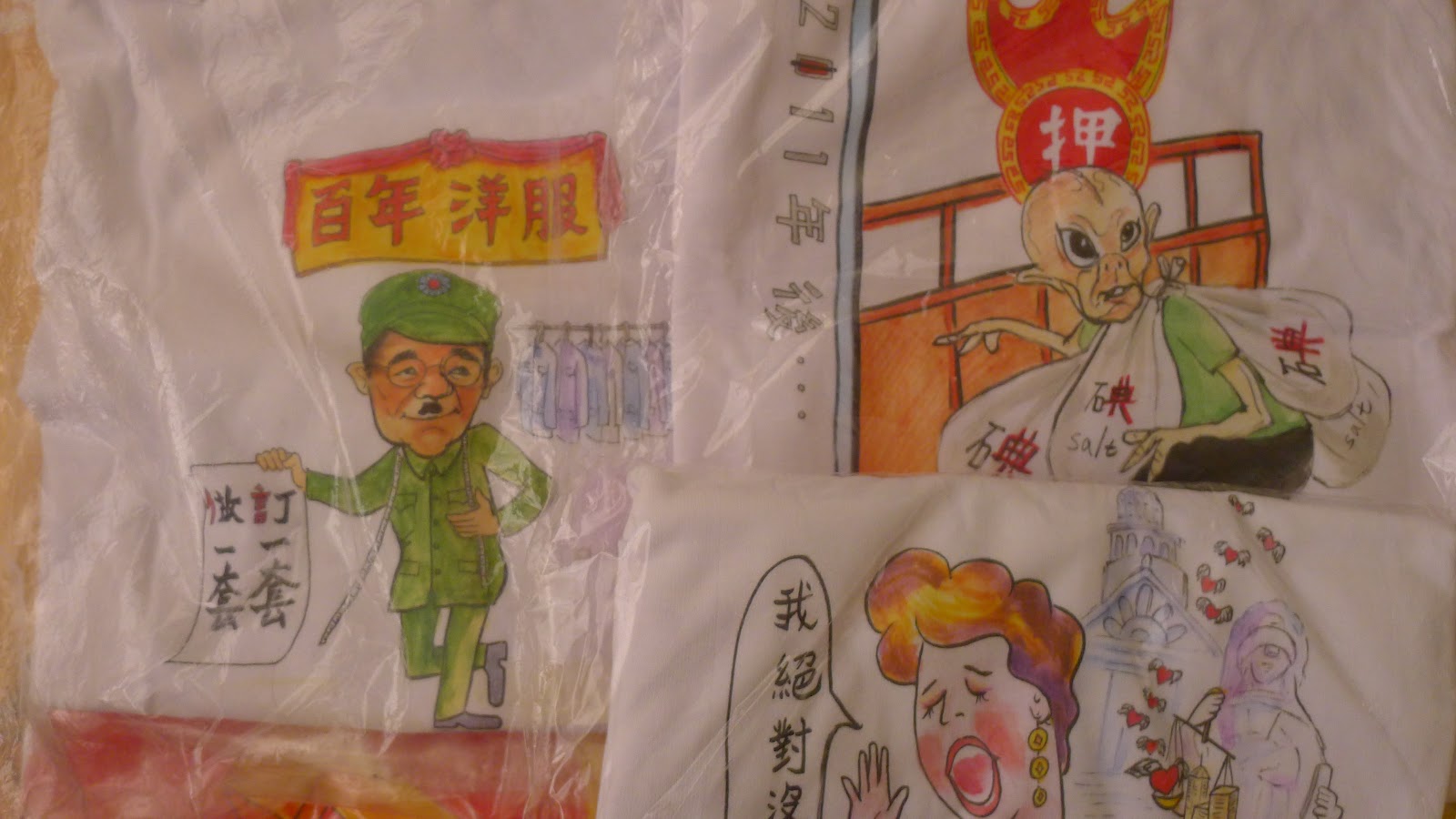
Given how antisocial I tend to be, I'm not sure if there will be many more posts under this 'people' heading. But that doesn't mean there are plenty of interesting individuals out in Hong Kong to meet. One of them would be Mr. Henry Wong, who also signs his work as 本地薑 (translates roughly as 'Local Ginger'.) 


I met him by chance back in May 2011, during a random visit to Wooferten in Yau Ma Tei, and encountered him during protests and other events around the city. He is a good representative of the mindset for many Hong Kong people; maintaining a day job but also yearning to find an outlet to express their political viewpoints. Mr. Wong chose to fulfil the latter need by creating witty and humourous t-shirts.


Each shirt is produced in limited numbers, and is specific to the happenings in Hong Kong at a given time. For example, there was a shirt for the salt-buying-scare during the Fukushima radiation leak in March 2011, and another covering the Chief Executive elections this March and April. The images aren't abstract, nor are they literal; it requires the use of brain cells to interpret the layers of meaning and Chinese wordplay. (Which is a difficult for me, since my Cantonese is bad enough on the surface level without even delving into the world of Chinese puns.) If one ever have the fortune to encounter Mr. Wong, he'll be more than happy give a step-by-step explanation to anyone who is interested. Though he would prefer if one took a stab and attempted to interpret it first; and one should do so, since we already live in a culture where images give us instant gratification. Being made to think for ourselves is a refreshing reversion to the pre-mass media and pre-advertising image proliferation days....


Mr. Wong will attend certain protests and events where he sells his shirts. There isn't a fixed price on them, since profit and money isn't his motivation. During the last encounter, he told a small group of youths that he spent roughly 40,000 HKD on this endeavour already, and will continue to do so because it is his 'hobby' and something he is truly passionate for. And he is sincere about his lack of emphasis on money; in my experience, he has never pestered anyone with immediate payment. (Though it doesn't mean he is flippant about money either; I gave him 20 HKD ages ago, and he still remembers-- even though I had forgotten-- and gave me some of his shirts this April. It is nice to know that there are still people in such an urban and mechanical city that can bring 'trust' into their interactions with others.) 


It is worth mentioning that the imagery is all drawn by Mr. Wong, who has had no formal training in the arts or with illustration. Which shows that no matter who one is, or what background one has had, does nothing to thwart the ability to contribute towards the city's diverse array of political voices. 

Thursday, 10 May 2012

Read: 推土機前種花


Yesterday was hot, yesterday was full of sunshine, yesterday was a sweat-fest. And finding myself in the area of Yau Ma Tei didn't help (urban heat island effect! Geography 101.) Thankfully Kubrick was nearby, providing air-con, a cafe with plenty of nice beverages, and a bookshop. Needless to say, where there are books, my wallet opens. 


So say hello to 推土機前種花 by 周綺薇 (Maggie Chow.) The book revolves around the neighbourhood of Sham Shui Po, with the introduction taking the reader back to a 2007 meeting at the Sham Shui Po District Council between government representatives and the residents affected by a 2004 government initiative to redevelop the area. The meeting degenerated into confrontation when the government accused the residents of 'illegally using government property'. Further exchanges between government workers and the affected locals resulted with the questions of the latter being met with obtuse non-answers and threats of police action from the former. Nothing shockingly novel about that scenario, since it is a widespread problem in current Hong Kong and is often reported in the media. 

But by introducing Sham Shui Po to the reader through the context of a conflict allows us to see that it is precisely these conflicts that emphasize, and render visible, the strong community ties that exist. The structure of the book is divided into six sections titled; the district and I; following the path of the neighbourhood locals; telling our story; love letter to the community; the flower gives fruit, the flattened land; and Postscript. 

The first section examines the nature of a neighbourhood, and the author makes such a narrative coherent by weaving her own background and experiences into the text. Instead of presenting her Sham Shui Po neighbours as 'faceless entities', she includes the names and backgrounds of those in her building, and show the linkages between them. By 'linkages', it refers to how they are situated within the physical space (e.g. Old Man 雷 lives in the flat under Uncle 李, Old Man and Old Lady 高 lives upstairs from the author on the fourth floor, etc.); or their role in the community (e.g. Old Man 雷 uses his medical training from his youth to give advice to neighbours, Mr. and Mrs. 馮 run a stationary shop that serves as a centre for news to spread around the locals, Limbu is from Nepal and runs a little corner store.) The best thing about these character introductions is that they are highly personalized, containing the little mundane details that are important to the author herself. 

The other sections takes the reader away from the seeming timelessness of the author's immediate social surroundings, and back to the the problematic world outside. The text then provides a chronological description of the major events that happened, detailing the neighbourhood's progression from voicing their ideas out in public, refusing to play the role of the victims, envisioning their ideal Sham Shui Po through the help of a Dutch activist by the name of Elena, and more. The book does a good job documenting the different events and discussions that take place at different moments in time. One event of particular interest would be the 2007 'Story Telling Gala' on Hing Wah Street, where the author helped erect huge posters formatted to look like the shop fronts of local business owners. People were allowed to interact with the store keepers depicted in the posters, and to leave write comments to stick onto the images. Another event infused with humour includes creating a series of worksheets for Carrie Lam Cheng Yuet-ngor (Permanent Secretary for Housing, Planning, and Lands in 2003/2004 and later the Secretary for Development) including lessons asking Lam to think about what it means for the government development office to put 'people' first (and who these 'people' are interpreted to be), what directions development should take, and the way of life in Hong Kong. 

Ultimately, the efforts of the residents did not stop the Urban Renewal Authorities from tearing down the affected areas, displacing the community and severing the complex network of ties that were there. But the author concludes the book on an optimistic note, as from this episode there sprang a new empowering consciousness within the local population, manifesting as The Sham Shui Po Renewal Concern Group. I for one, am curious to know 'what is next?' and to see what sort of strategies the Group will employ in the face of future government development.      Other questions include; what does the author see as 'ideal development'? In the author's view, what is the degree of effectiveness in the strategies used? And while there are lessons learnt by the local residents, what can the government take away from all of this? How does development practices in Hong Kong compare to those abroad, and is there a model from abroad to learn and copy from? The book manages to force the reader to look with a critical eye at the term '活化' , and to rethink what 'urban renewal' really means (to replace or to rejuvenate?) 

On an unrelated note, is it hard not to notice the plethora of lovely illustrations and photographs in the book, rendering it almost into a graphic novel. 

Book retails for 110HKD at Kubrick (99HKD for Kubrick members). It is 148 pages long, published by MCMM Creations in 2011. Mostly written in Chinese, with a few pages of English translation in the back (though I must say that the English does not fully cover everything mentioned in the Chinese sections.) 

Sunday, 6 May 2012

Weekend: Yau Ma Tei (through Wooferten's Mobile Bar Battle)


Yau Ma Tei was originally a village, though the exact meaning of the name 'Yau Ma Tei', and the industry the name harkens from, is unknown. (Funnily enough, the MTR tried to name the station there as 'Waterloo', after Waterloo Road, when it first opened in the 1970s.) Urbanization made it almost unrecognisable from its historical image; it once had its own bay and beach, and now it is a part of a densely populated hub quite a ways from the water. You can tell how the coastline has shifted thanks to the aptly named Reclamation Street to the west. Following Wooferten during one of their weekend events was a good way to catch a glimpse of just how fascinating the area is. 

Wooferten (浩化廳) is one of my favourite places, calling itself as a community art space, something that is rather lacking in this city. And they do take 'community' seriously, welcoming neighbours to gather and sit in their space on Shanghai Street, and initiating outreach events to bring people together. 


Last weekend, Wooferten (alongside 素人之亂 from Japan, and with the help of Mr. J) hosted the Mobile Bar Battle , with the slogan of 'Hong Kong Never Drunk'. The purpose was to hand out free alcohol to the locals in the area, but instead of making them come to the art space to get it, the alcohol was brought to them. The event featured the locally-brewed Yau Ma Tei beer (see previous post), also providing a fair share of store-bought canned-beer, and miscellany alcohol that Mobile Bar Battle participants brought. As the visiting Japanese activist at Wooferten said, alcohol is a social lubricant, bringing people together. And true to his word, the turnout was awesome. 


Some photos to share: 
Wooferten at 404 Shanghai Street, just before setting out for the neighbourhood. It was hot, it was very sunny, it was sweat-inducing. But it was well worth going

Waving banners, pushing trolleys and carts of beer around. The planned route took us through a couple of blocks in the area

So adorable! But never fear, no minors were given alcohol. This little girl contented herself with Vita brand lemon tea and some roast pork from the cart

Walking past the corner houses (more details about these in a previous post) that are so common in the area. The great thing is that you can still see how 'lived-in' these buildings are

Couldn't resist photographing this wonderfully illustrated bag (reads 'this city is dying'), especially since it echoes the current sentiments of many young people in HK. 

Sharing the roast pork around. Couldn't grab a piece, since the young'uns and the elderly were given first dibs

Heading down the wet foods market on Nelson Street

Pouring alcohol to anyone (over 18!) who wanted it 

Cheers, matey! 

Ending the Mobile Bar Battle route at this local park. Live music, casual chats, a jovial atmosphere all around

Credit goes to Wooferten for their effort in providing the goods used in the Mobile Bar Battle
Overall, the event was well-received by people in the locality. There was the occasional person who overtly comments on how the Mobile Bar Battle group was 'being pointless' and 'doing something rubbish', but who cares? Local stall owners waved and sampled the alcohol, people in windows waved, and a lot of people were smiling as the group walked by. Patrolling policemen jokingly said they might try some when their shift ends. And the fun wasn't only experienced by the people we encountered, but the Mobile Bar Battle was also fun for those of us who tagged along. 

Tuesday, 1 May 2012

Musings: Alcohol

It isn't fair to say that this is my musing, since most of the content of this post came from a conversation with Joshua (better known as Mr.J, check out his facebook misterjishere), a Hong Kong-based performing artist with a serious interest in brewing alcohol. I chatted briefly with him during an event jointly held by him and Wooferten last Sunday, where participants roamed the neighbourhood handing out free alcohol to all sorts of people, which will  be discussed with more depth in the next post. Here the focus will be the musings about alcohol itself, so now, thinking caps and beer goggles on! 

The brewing maestro
Together with Wooferten, Mr. J created a batch of beer that can truly be called 'local'. Brewed locally, using local ingredients. For example, the process of fermenting alcohol requires sugar, but rather than use the boxes of powdery snow-like sweetener you see in the supermarkets and coffee shops, peen tong (aka brown candy that comes in slabs) was used instead. It isn't commonly known that the use of peen tong in the kitchen is confined more or less to the Southern Chinese provinces, Hong Kong included. These small details are a big deal, affecting the overall taste of the product.

And most people were surprised to learn that it was possible to brew alcohol right in the middle of a densely populated, space-sparse, and aging neighbourhood of Yau Ma Tei. If one is brewing as a hobby, and the product is intended for self-consumption, the amount you can brew inside the tiny flats of this city* is limited to how big of a bottle you can find to contain it all (based on what I've seen on Sunday, it looks as though the 4.5 litre distilled water bottles were the most popular.) The fermenting process can take as long as you like; Mr. J would let a brew sit for two weeks, though Wooferten managed to produce a batch in a week and a half. The Wooferten mixture was a little murky to look at, but based on the reaction of those who sampled it, the flavour was nice, and the alcohol wasn't too strong (a plus or a minus, depending on who you are.) 

And viola! The product that made its public debut last Sunday, coming in three flavours ranging from oolong and mint to something akin to lemon tea. The label reads as 'Yau Ma Tei beer', with a design from Wooferten that harkens to the good ol' days in Hong Kong history (though someone jokingly said it looks like a bottle of medicine instead of a beverage... ) Classy and humorous 
If one is asking why there is such an emphasis on 'local', maybe it is better to ask why we don't seek locally-made products instead of relying on imports? Asahi is from Japan, Tsingtao is from mainland China, Corona Extra is imported from Mexico, Heineken is from Amsterdam. Sure, Hong Kong has its own breweries for brands like San Miguel, and the production of Blue Girl in South Korea is monitored by a Hong Kong corporation, but the former is partly owned by overseas stakeholders and the latter retains its German roots through its formula and the brewing process. Both beers aren't even marketed as local; with the San Miguel commercial playing up its European appeal, and Blue Girl featuring a bunch of foreign youths climbing up a tree in a tropical rainforest trying to photograph multicoloured birds. So is there an alcohol that can be seen as representing Hong Kong? And what sort of traits will it have to distinguish it from other alcohol across the globe? It was a challenge undertaken by Wooferten and Mr. J this past Sunday, and I think while this effort is still nascent, it is a good showing. 


The 'localness' of a beer ignites a few musings, but getting involved in the production of beer itself leads to other tangents of thought. Mr. J evoked questions of what alcohol really is, and what meaning lies behind the terminological divisions between wine, beer, ales, etc.; a rather philosophical vein of inquiry. As for me, the production of individualistic and unique alcohol relates to a concern resonating throughout current Hong Kong society; specifically the lack of consumption choices presented to the population. Most of what is ingested comes from large corporations, notably the titans of Wellcome and Park'n'Shop that overshadow and oust the smaller grocers. We've become accustomed to being provided for by these retail chains that we've forgotten the actions of making, and are instead transformed into creatures whose only action is to open our wallets and hand our money over to a cashier. Our role in the production of our own foodstuff is greatly diminished in this city, and while I'm not saying that everyone should immediately run out of their office habitat and start ploughing the land, we shouldn't completely discard the agricultural past and knowledge in favour of everyday conveniences. So be it a hobby or a profession, growing peas in a pot or brewing alcohol in a bottle, any means of re-establishing or maintaining a direct link to the land (and our stomachs) is appreciated.


Hm, who knew that a post revolving around alcohol can result with all this text? 


*Before any alarm bells ring regarding the legality of home-brewing, the government states that no license is required provided  the brewer is of age (18 in this city) and that none of it is sold. One is also limited to a maximum of  50 litres of home-brew, but it is doubtful that this quota can be reached by most people. 


----------------------------------------
Read more: 


-Government legislation page pertaining to home brews
-New York Times article on Local Brews (though granted, this was written back in 2009, and given the high turnover rates in Hong Kong, who knows if any of the listed establishments remain today?)