Showing posts with label Demonstrations. Show all posts

Thursday, 6 June 2013

Reflection: Back in 1989


Although unable to be at Victoria Park in Hong Kong this year, I was happy that a lot of young people I encountered during fieldwork attended the candlelight vigil to remember Tiananmen 1989. They stood in the crowded park despite the rain and the high temperatures. Across the other side of the Eurasian landmass (and a hop over the English Channel), there was also a small memorial service dedicated to Tiananmen victims, organized by a group of Hong Kong students in the U.K. Much like the crowds at Victoria Park, attendees here were varied; some had only heard of 4 June in passing whilst others had attended the vigils in Hong Kong every year; there were students from the PRC and from Hong Kong;  some were children in 1989 and others were yet to be born. 

Because Tiananmen had an impact on my life, and the lives of many others in my age cohort, I thought it would be nice to briefly share some related thoughts and feelings here. I detest writing about myself (though it is likely I unknowingly insert my ego in other posts) in fear of being accused of egocentricity. It is also because my life isn't rife with the drama that interests others, nor have I done anything significant and important thus far. But perhaps my experiences and memories of Tiananmen share commonalities with the experiences and memories of other people, and can be considered a part of a much bigger 'collective memory' that floats over our generation...maybe that is why it is worth writing, I don't know.

I've encountered comments that people my age are too young to remember; that our memories are either too vague to be worth talking about, or are only constructs from secondary sources. But I believe it isn't only about being able to witness the facts first-hand. Speaking to a friend who was an undergraduate student in Hong Kong during 1989, and who continues to be involved with 4th June events today, he remembers the crushing feeling of pessimism upon hearing about the Beijing crackdown. It was a pessimism made more intense because it was shortly preceded by widespread optimism; optimism that the Beijing students and residents can succeed in their aspirations, can win democratic and expressive freedoms, can challenge the upper echelons of government power, can prove that people can mobilize to change the parameters they face in life. A lot of these ideals vanished when the tanks and bullets arrived... The point is, for this friend, it doesn't matter whether people in our generation existed when Tiananmen took place, because there is an emotional component in remembering history that is capable of transcending generational barriers. 

My memories of 1989 in Hong Kong are fragmented. My family was living in a small apartment in Quarry Bay at the time, and I saw the footage when we were sat around a folding table for dinner. Being a toddler lacking the intellectual capacity to comprehend the inferences from the happenings in Beijing, the television screen looked like a chaotic mass of colours. It was only by looking at my parents that I knew something was wrong, since they both stopped eating and became very quiet. Their quietness disappeared during the subsequent demonstration in Hong Kong, where both my parents tied ribbons around their foreheads (and the foreheads of my sister and I) and shouted slogans. I don't remember much of the demonstration, only that it was loud, crowded, hot, angry. Because of my short stature my dad sat me on his shoulders; but even at that height, my field of vision was only filled with faces and heads. As a child, that was an intimidating sight (my mum said I burst into tears); but thinking back as an adult, I find comfort knowing that so many people felt compelled to speak out.

Tiananmen was one of the reasons why my family emigrated from Hong Kong to Australia later in 1989, and why I became better versed in English than Cantonese. If we never emigrated, l would have grown up in Hong Kong, and have become someone different-- not better or worse, just different. Kind of strange to see the diverging points in your life, to know that so many possibilities were/are out there... The crackdown resulted with a steep learning curve about the key actors and activists involved in 1989, led to a general interest in local and international politics, and shaped my current research interests in school. It influenced my moral worldview; especially perceptions of right and wrong, good and bad, justice and injustice. 

Personally, remembering 4th June is not only a historical exercise, but a moral one. We remember that people died in Beijing in 1989, and died unjustly at the hands of Communist Party officials; the PRC government has not acknowledged this, denied the relatives of Tiananmen victims their right to mourn, and reacted by imprisoning activists. We remember so that we can continue to demand for individual rights and freedoms, and if it does become realized one day, that we never take them for granted. Already we can see such freedoms being encroached upon in Hong Kong. The city is supposed to be last place on 'Chinese soil' where Tiananmen can be discussed, but unfortunately we can see media outlets toning down their Tiananmen coverage under self-censorship, with conservative political forces and the SAR government officials avoiding all mention of 1989. (I sometimes wonder what can compel these groups and individuals to deny Tiananmen; how differently do they see the world, and how did they turn out so different from those who do care?) 

Thankfully, there are young people in Hong Kong who remain determined to ensure that the memory is passed to their successors. There are those who attend the candlelight vigils. Others experiment towards expressing their thoughts towards Tiananmen through novel outlets; there is Woofer Ten's來往廣場的單車 (Cycling to the Square) that took place in 2011 and 2013, and 這一代的六四 (This Generation's 4 June) that has been running for the past several years (see the post on this blog from last year). I find myself happy and proud to know that there are people who remember, and will continue to remember...

(Please excuse the poor quality of the illustration in this post: am still waiting for the laptop to be fixed.)


Saturday, 11 August 2012

Weekend: Demonstrations (1 July Handover day)

1 July is a bipolar day. Part of the population would be celebrating the handover of Hong Kong from British colonial rule to Chinese sovereignty. Another [larger] part of the population will take the streets in what is now for them an annual occasion to protest on the streets. 

I've heard the criticisms about these demonstrations on 1 July becoming ritualistic, devoid of the meaning it held back in 2003 when the feeling of solidarity was strong; when all sectors of society united to repel the implementation of Article 23. Others would think the protests are pointless, given the image of relative economic prosperity Hong Kong projects. But even with Article 23 now shelved indefinitely (that is what the officials say, but then again, Chief Executive CY Leung said he would never run for the position), the issue still hasn't gone away. And there are new problems to take to task. Never has the wealth gap become so wide in the city; or was there such an obvious attempt being made by a governing body to exert control over the creative sector. The new Chief Executive is plagued by his illegal structure scandal, to which he never provided adequate answers for. Mainland activist Li WangYang's death remains unaddressed, costs of living are rising and hindering the social mobility of the younger generations. 

These issues don't dissipate after a single demonstration; many remain unresolved and cumulate to increase social tensions through the years. It could be because Hong Kong is a society that loves complaining, or that the SAR government is doing a fairly shoddy job. I'm inclined to believe in the latter. 

There are plenty of written material covering the demonstrations itself (newspapers, televised news, blogs, etc. Not to mention compilations of academic essays...) so without rambling on too much, here are some photos: 


Mr. Kacey Wong as the 'real' Cultural Bureau chief, in his pink tank. His secret weapon? A stack of hard cash to pay the art protesters off. (Unfortunately, money/funding does dictate the fate of many art endeavours in this city, and artists are increasingly feeling the squeeze from high rents. Not only are young artists struggling to survive with the tide of rising rents, even academic institutions aren't immune. The art department of Baptist University is currently under threat, with the rent skyrocketting within a short period of time and proving to be unaffordable by the institution. BU students have started a protest action, citing that the government was basically setting the costs so high to deliberately force the students out.) 

Example of the money being handed out by the 'real' chief (personally, I find these bills much more fun and interesting than the real currency we use.)

Placard reads " don't stand out today, may not be able to stand out tomorrow"...such fears are not unfounded...

...given that there was the proposed limitations towards works of parody in the city. Article 23 makes a comeback as a theme.

Hello Kitty was another recurring motif; shame on CY Leung for using the iconic cat as an excuse during his illegal structures scandal

To the new Tamar government building, where the theme was 'Doors always Open'. Not as opened as one would believe...they let protesters into the courtyard, but no one was there to listen. I suppose they expect the Hong Kong inhabitants to protest during office hours. 

Marching even after the sun sets, anger not confined to daylight hours. The last of the crowds didn't leave Victoria Park until late in the afternoon/early evening, so I'm not sure how the police can even justify their estimate of a 65,000 turnout. They ought to make all their recruits take a maths class in basic counting.

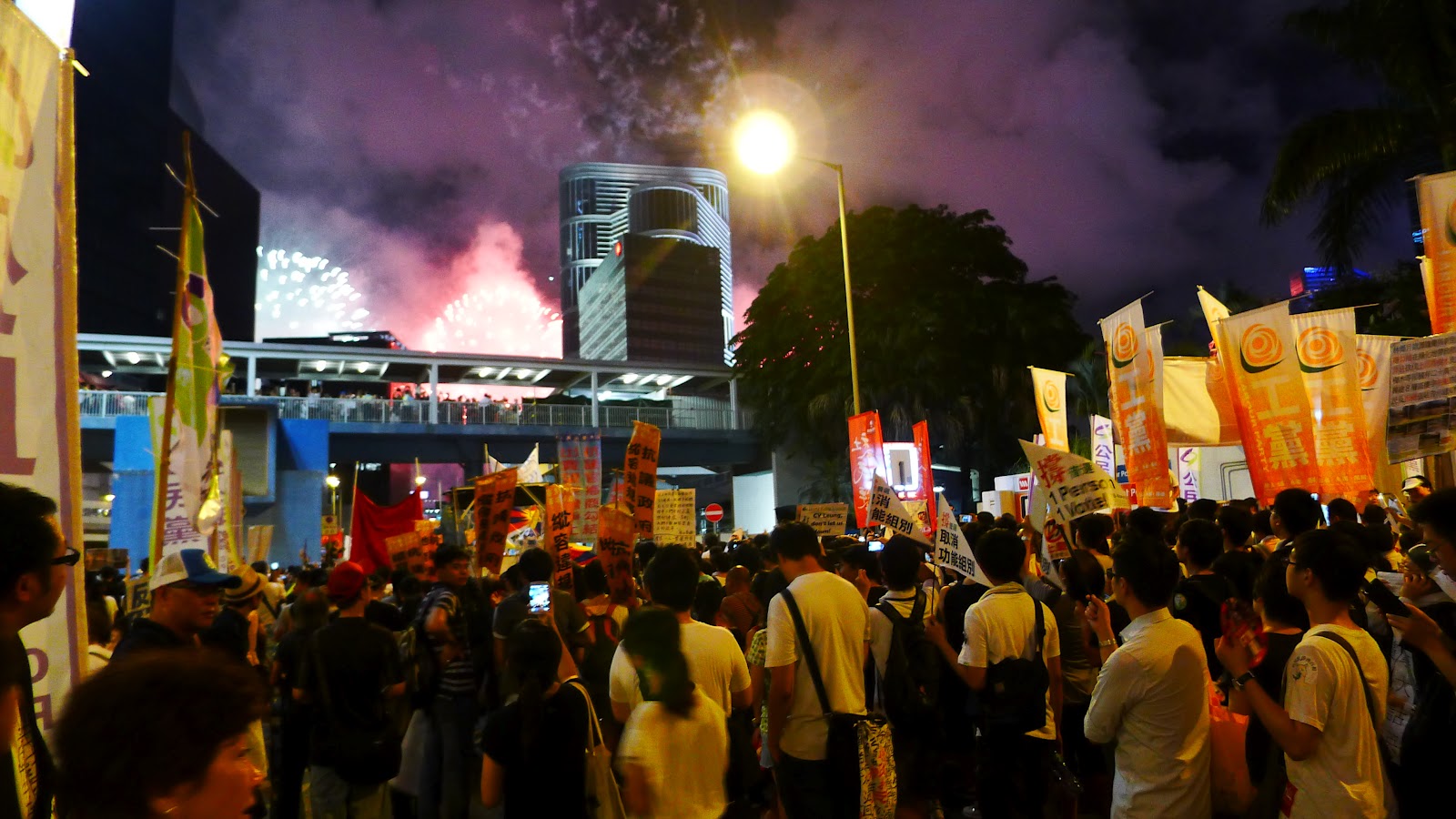
Fireworks celebrating the handover being booed by the protesting crowds. Shows how disconnected the SAR government is from public sentiments. (On a personal note, the entire atmosphere was incredible. Hearing the fireworks echo all around thanks to the tall buildings, and seeing the lights in the sky accompanied by the shouts of the crowd, was strangely touching.)

[This post is more than a month late, but a few personal events cropped up (resettling back in the U.K.) and it took time to get everything sorted out. Just because I'm now geographically distanced from Hong Kong, doesn't mean I would be any less interested or angry at the events that happen there.]

Monday, 2 July 2012

Drawings: Reign of the Wolf


Now that July has arrived in Hong Kong, CE-elect Leung has been upgraded to CE. Is everyone happy about it? Not from what I saw during the annual protest on Handover Day. Embraced by a whirlpool of allegations, scandals, integrity issues, and low popularity amongst the Hong Kong public (surprisingly enough, wikipedia has pretty detailed information on the events that went down throughout the entire 2012 CE election debacle. Though I must make an addition; whilst Tang had an illegal structure in his house, it turns out that Leung has six.) One must wonder why we even voted for him to take the post at all. 

Oh wait. We didn't vote, because we couldn't. The CE is chosen by a small, select group of individuals (most of whom are alleged to be pro-Beijing due to their business ventures), much to the ire of the population. The motivations behind this practice is unclear (for the public, anyways), though definitely not because Hong Kong people do not want to vote. PopVote is a great example of this will to choose our own 'leader'. It was an informal voting session arranged by HKU that took place in March, which allowed the public to choose who they wanted for CE. It might not be recognized by the HKSAR government, but was treated by the organizers like it was the real thing, with proper ID checks. Despite the initial setbacks (the PopVote website getting hacked and the confusion of converting to paper ballots), and the long waiting time endured at the polling stations, PopVote received a turnout of over 200,000 ballots.   

The results from PopVote showed that over half of the ballots were cast as blank. And yet with these results showing such low public popularity for all of the candidates, inclusive of Leung, he was still voted in office by some faceless batch of people. And already his behaviour has not been promising; low points include his unwillingness to comment about the circumstances of mainland activist Li Wangyang's death, his 'shock' at realizing his own abode has illegal structures (Hello Kitty does not approve! You'll need to check facebook and old news clips to et the reference), or unwillingness to answer a reporter's question about the 2012 Handover demonstration yesterday evening. Are we going to have a CE who deliberately disconnects himself from the questions that Hong Kong people want to ask, and in general, who doesn't answer questions at all? 

(And before any of us forget; now that Leung is in office, he better uphold his promise from the CE elections to release the minutes of what transpired during the confidential Executive Council meetings about how to handle protesters in 2003.)

On another note: why are all of our CEs so messed up? Can the higher-powers of Beijing honestly not find a single decent individual in Hong Kong to take the position? 


(The extended version of the logo, with a police baton in one hand, and pepper-spray in the other. In recent times, the Hong Kong police has been incredibly heavy-handed when approaching protesters. They haven't used batons (yet), but they have pepper-sprayed protesters as though they did a bulk-buy of the stuff at a special sale. Always strange to see tax dollars being used against tax payers.
The police's rationale for using this sort of force was that protesters enacted violence upon them; but what, and where, is this violence? Shaking a few police barriers? Refusing to move away from an area? And is pepper-spraying not a form of violence towards protesters; in which case, will the police be held accountable for that?
And honestly, it is quite irritating that some members of the observing public would blame the protesters for getting pepper-sprayed. I reckon that is a rather unhealthy mentality to adopt. First off, the police aren't exactly an innocent party and has been shown in some instances to instigate conflict; secondly, the key is to look at why the protesters acted in the way they did to result with such police action. Oftentimes scuffles arise from poor police planning, especially with crowd control or reducing the width of the protest routes...
It appears depressingly probable that this sort of police behaviour will continue in the near/far future.)   

Monday, 11 June 2012

Weekend: Demonstrations (我們都是李旺陽)

Demonstrations in Hong Kong are one of the most common means of expressing a message within the local political scene. They are different from demonstrations in many other countries; in the sense that in this city, they are perceived as being incredibly peaceful and orderly. Despite this image being challenged given the [understandable and oft misconstrued portrayals of*] conflicts with police in recent years, demonstrations remain almost a weekly affair, but they tend to be of small-to-moderate scale (a turn-out of around a hundred to a thousand people), and of specific scope in their demands. This plethora of protests is thanks to the fragmented political and social scene in Hong Kong, where individual groups voice their own interests which may exclude and alienate the sympathies of others. This is pretty consistent throughout the year, save for large-scale happenings such as the candlelight vigil of the 4th of June and the annually-expected 1st of July protests. 


But there are occasionally events that occur which temporarily puts aside the differences of many political parties (sans DAB. Always sans DAB.) and draws large numbers of people onto the streets; in this instance, the 'suicide' of activist Li WangYang who was imprisoned in the mainland for two decades and was found dead under suspicious circumstances.


As if the suicide wasn't dodgy enough as it is, sentiments of anger precipitated in Hong Kong after the CCP issued a series of answers and explanations that did not....answer or explain anything. (Avoiding the jokes that Hong Kong people watch way too much CSI to be easily accepting of the obscured conditions of Li's death, even foreign tourists in Wan Chai said that there was no way Li could have killed himself based on the scant imagery that has been circulating online. The international community knows...) The obvious questions have been circulating in the media and social networks; why would a man with no intention for suicide suddenly take his own life? Where would he even get the rope to hang himself? How does a visually-impaired person with limited mobility manage such a feat anyways, especially since it could be assumed that he was under the watch of CCP officials since his release from prison? These questions aren't the most ire-invoking matter; it is the CCP's contradictory practice. Promising an open inquiry but immediately cremating the body of Li, and monopolizing access to the surveillance recordings to Li's room. Cutting off contact between friends of the Li family, and those who promised to aid in their search for truth. (Check out the Wall Street Journal blog for a more fleshed-out account on the happenings.)


Hong Kong people don't have the answers, and any ideas offered will remain speculation. But they can demand for transparency and for the facts to be made clear; they can show their horror at the maltreatment of activists in the mainland; they can pay their respects to the man who fought for the recognition of the killings on the 4th of June 1989. And so this weekend, the inhabitants of this city made their feelings towards this matter be known, and took to the streets under the theme of  '我們都是李旺陽' (translates to 'We are also Li WangYang'. Over a dozen organizations and parties banded together for the demonstration; I opted to partake with Art Citizens, a group formed by local artists and people concerned with the arts. (They debuted last year in the protest calling for the freedom of Ai Wei Wei, and also on the 1st of July 2011 against police demands for no music to be played during the annual protest.) Check out the photos:

Starting from East Point Road in Causeway Bay 

White shirts, white banners, white flowers; a funeral procession 

Blindfolded and waving banners with poems written on them

People from the group marching behind Art Citizens. It was a hot day, and there were many standstills during the march, so it very tiring

During one of the longer standstills just before reaching the Beijing liaison offices. The entire street was packed (can't see all of the people in this photo because many of them were around the corner where the main road was), and I'm pretty sure that the police estimate of 5,400 attendees is fairly off.    


I think underlying this demonstration calling for transparency in Li's death, are deeper concerns within the Hong Kong psyche. What is the worth of a human life to the CCP these days? What is the worth of a human life to us? Can we live our lives quietly and in a docile manner knowing that the CCP has not been held accountable for their actions towards activists in China? How long will it take before the CCP will acknowledge 1989, and how long till the democratic ideals from 1989 realize itself into Hong Kong? Will the imprisonment and mistreatment of activists in the mainland be a glimpse of what is to come in Hong Kong? Can we move away from being a city only concerned with economic development and towards being one guided by a sense of morality?


-----------------------------------


*the idea of 'disorderly protesters' who 'instigate' and 'provoke' conflict is a dangerous myth. It needs not mentioning the issue of media bias, selective reporting, and the recognition of the media as a corporation out to sell a story using the most eye-catching images. You do have a tiny number of people in the crowds who are egging for trouble with the police, and they are responsible for their own actions. But if you have been near that situation the first thing that happens is that fellow protesters will talk the individuals involved down from open conflict. 


Sometimes (or better to say oftentimes) it is the Hong Kong police that overreacts, leading to scuffles; they say that protesters are 'violent' and pepper-spray them, but what is this 'violence' they speak of? Shaking a few police barricades? Trying to resist against the oft-unreasonable restrictions imposed by police to the demonstrations route? The definition of 'violence' employed by the Hong Kong police has a pretty low threshold, especially when you compare with the 'violence' that occurs around the world. (And looking back at the debacle of the HKU 100 celebrations, where police confined students in the campus stairwell, what was the supposed offence of the affected students? The simple act of shouting for democracy on campus grounds during the mainland vice-premier's visit.) 


Not saying that the Hong Kong police should be painted in an antagonistic role; many them do try to be helpful, keeping protesters away from passing traffic and keeping in communication with the protest organizers to ensure that things are going along as planned for both sides. (And I won't even hazard a guess into the sort of conflicts they go through trying to juggle what their jobs demand and wheretheir personal sympathies lie.) But then you have police officers doing this sort of thing: check out this video on youtube showing how a police officer grabbed the head of a youth protester who was turned away. Completely unwarranted, unjustifiable, and unfortunately for the sake of all, unnoticed in the mainstream for now. For a police force that is so against 'violent measures', they sure don't have an issue employing it for their use.