Showing posts with label Wanderings. Show all posts

Wednesday, 27 June 2012

Wanderings: 榕樹頭 (Yung Shue Tau)


Temple street (廟街) in Yau Ma Tei is well-known to tourists, but thankfully hasn't been overwhelmed by their visits, managing to retain a strong local presence and character. It resembles Tung Choi Street/Ladies' Street in Mong Kok; except Temple Street is also known as Men's Street. Which isn't to say that the merchandise of these street markets are limited by its gendered name. Ladies' Street does have a mountain of handbags (no guarantees on the authenticity of such goods. I must say that they aren't as blatant with their knockoffs now as they were then), but also offers fruit, electronic items, cell phone accessories, beach towels, stuffed animals, etc. And while Temple Street focuses more on male clothing, you'll still find stalls that sells pretty much everything in between. The enterprising mind won't be limited by geography...

Another notable difference between Ladies' Street and Temple Street is that the latter area provides a gathering ground for many of the city's elderly. Particularly Yung Shue Tau (榕樹頭), a public square at the heart of Temple Street, named for the banian (banyan) fig trees situated within. During the day it is frequented by ah baks sitting together for a conversation or a game of chess. In the evenings, the fortune tellers and other vendors emerge to cater to a bigger, and more diverse, crowd. Unlike the rest of Temple Street, it provides a stage for Cantonese Opera street shows, and live singers...(funnily enough, live singers are also taking to the streets on Sai Yeung Choi Street South in Mong Kok, just next to Ladies' Street/Tung Choi Street. Another parallel between the Ladies' and Men Streets?)

Judging from the Tin Hau temple there (the namesake of Temple Street), you can discern that the Yung Shue Tau area has a fishing-based heritage. The area has a long history, probably back when the Qing dynasty was still in control of China. I'll guess that the boundaries of this public square wasn't as well defined back then as it is today; the major roads (Shanghai Street, Public Square Street, etc.) currently surrounding the square didn't emerge until the mid-to-late 20th century, and now limits the possibility for spatial expansion. Photos below, with some lengthily captions: 

Old people socializing; who needs facebook when you can talk face-to-face? (And no, facetime does not count)
Tin Hau temple, actually a huge complex of other temples including a now-defunct Hsu Yuen (translates as 'study hall'. These are the predecessor to the current schools in Hong Kong. Once there was an established education system in the late 1800s, they were rendered obsolete. This one is currently a place for fortune tellers to set up their stalls.) They were constructed by local fishermen in 1865, and was finally relocated to their current site at 1876. Asides from the Tin Hau temple in this photo, there is also Shea Tan, Fook Tak Tze, and Shing Wong. More details of the latter in the next photo.
Surprisingly enough, few people realize that this temple is different from the Tin Hau temple next to it. The 城隍廟 (Chenghuang Temple/ Shing Wong Temple; differences in romanization depends on the area where these temples are found.The former was used in Shanghai, the latter in Hong Kong) roughly translates to 'City God Temple' and is fairly prevalent in most major cities that have a strong following of Chinese folk spiritual beliefs. The 城隍, or City God, is a class of deities in Chinese mythology that offer protection over the city (protection ranging from personal to communal concerns...and all kinds of disasters such as drought.) It is not to be confused with the more localized and familiar 土地公, which in itself is a huge topic, better explored in a later post...

The establishment date of the first Shing Wong temple is a bit confused; wikipedia says 1877 and locates it at Shau Kei Wan on Hong Kong Island, the Tung Wah Group (a charitable group in charge of managing some temples in Hong Kong) credits the 榕樹頭 temple of Yau Ma Tei for 1865. Either way, it is interesting to note that both dates are after the city has been colonized. Before the British arrived in 1841, most major Chinese cities had their own City God. Except for Hong Kong, since the place could hardly be considered a city at the time... 
Buildings spotted around the area; this corner house is an old fashioned restaurant, famous for its retro fittings
More old buildings, love how they are so colourful. Hong Kong is home to a multitude of buildings in shades of pink, purple, green...all colours of the rainbow (and Choi Hung Estate in Kowloon really does have a rainbow palette...since 'Choi Hung' translates to rainbow.) 
One entrance to Temple Street, just before the stalls open for the day. I'm pretty sure this is a new fixture, though the reasons for installing it here (or now) remains unknown. Is it akin to those efforts one sees in the Chinatowns of Sydney and London that try to make these areas more 'Asian', to appeal to the tourist mindset? (And is it ironic that with this 'gate' in place, that it reminds me more of Chinatowns in overseas locales, than it does of any other place in Hong Kong?)

Trivia! You won't find the area by typing its name into googlemaps (the closest it'll take you is to Ngau Tau, off Lamma Island.) Yung Shue Tau is a name used amongst locals, so if you ask around they will know how to give directions there. You can also find it where Shanghai Street intersects with Public Square Street. 


-----------------------


The street is the favourite seedy place of our imaginations in Hong Kong. Some of us were told not to venture to Temple Street alone during our childhoods, which fuelled the perception of dodgy happenings in that area. (It isn't as though Ladies' Street is crime-free, but it just feels as though the crimes committed there lack the gravity of those at Temple Street. Maybe Ladies' Streets seems more 'open' and 'approachable' because it is better connected to the main transport links...) The rumours about gang extortion of money from Temple Street vendors didn't help (hey, even Hong Kong films made Temple Street look like the romping grounds for gangs), nor did the evenings news a couple of years back featuring the street as the site of an acid attack 'from the sky' (someone threw a jar of acid from one of the many high rise flats in the area.) Sex toy stalls made the area look almost like the red-light district of Amsterdam, albeit the Hong Kong version looking more disorderly (and without the overt displays by prostitutes.) And then several months ago, during a dinner conversation, I overheard a story about these sex toys being sold-then-resold to unwary customers...without being cleaned in between transactions. Probably a fabrication, but this is the stuff urban myths are made of. 


Tuesday, 10 April 2012

Wanderings: Blue House, Hong Kong House of Stories


Blue House is a known tourist attraction, but few out-of-town visitors would know about the 香港故事館 HK House of Stories (check out their facebook page, and also their website) situated in one of the old shop fronts on the ground floor. 


The current banner roughly reads as 'WanChai Residents House of Living'. From March 2012 onwards, they will be named as the 'Hong Kong House of Stories', to expand their scope not only to WanChai but to the entirety of Hong Kong. 
I was there to check out their current exhibit held by the YMCA creative arts programme (runs until the 12th of April), whereby a group of post-80s youths were chosen to produce an art piece investigating their relationship with the past, represented through interviewing their own relatives from previous generations. These narratives are linked by the 'past and present' theme, and are also bound together by their common manifestation as a book (booking-binding pun intended.) They are not necessarily representative of an entire generation's approach towards the past, since they are highly personal (one decided to create a book shaped like a beer that was important to their interviewee, another recreated their grandmother's suitcase, and then there was an introspective account about one's changing relation with their father), but maybe this is more constructive in many ways? The post-80s youth are a diverse lot, and it wouldn't be fair to clump all of their voices together in a generalized summary. 

Note: the exhibit is mostly (almost entirely) in Chinese. 

In line with the 'past and present' theme, here is an interactive display to link 'present with future'. Write a letter to yourself, put it in the envelope with your address, and the staff at the House will send it off to you within a couple of months. Only applicable for those with a HK address...
And at the end of the gallery, you can leave behind your comments for each 'book art'  inside its designated opinions book! Feel free to sit on these tiny iron chairs, which were popular for a while in Hong Kong.
One of the employees at the House of Stories was nice enough to give us more information about the place itself: the House is currently an exhibition space, but alternates between holding workshops and forums. It also provides a home for old items that belonged to the elderly residents of WanChai who were forced to move away because of the soaring rents/cost of living, a consequence of inflation and the continuous efforts from estate developers to gentrify the area. (For example, the employee gave rough approximates regarding the cost of the new apartments across the street targeted at young professionals. They used to be valued at around 9600 HKD per square foot, but within the past two years, this has jumped to 14000 HKD per square foot.) 

All the furniture inside the House are donations from residents of WanChai, who have moved away and could not bring these possessions to their new abodes. These items aren't rare and expensive collectibles, but are chosen precisely because they were everyday objects that may still be seen and made today. The point is not to highlight to quirkiness of the past, but to make it relatable, allowing current visitors to see how the items were 'lived in' and used. (Alluding to the text by Appadurai about the 'Social Life of Things', whereby the object itself is not important, but rather the meaning and stories behind it.) 

Collecting physical objects aside, the House also keeps a roster of all the people who moved away and where they are going, so that the previous residents and way of life won't be easily forgotten in this city where memory is fleeting. 

High ceilings inside the Hong Kong House of Stories, reflective of the old-fashioned design of the Blue House. Postcards, photos, and other memorabilia are sold to help maintain the space, since the NGO in charge is non-profit. 
Sign alluding to the previous purpose of the space now used by House of Stories; an old wooden alcohol license remains. These shops lack of any particular layout schematic, which is a trend of the past. Stores were given an empty lot, so that they could arrange their furniture and partition the store space however they want. 
The House of Stories focuses on 'community', especially on 'preservation through documentation'. Of importance is the changing forms of community ties, described as 'weakening' due to the modern way of life in Hong Kong. The old residential blocks, while often small and portrayed to be inhospitable domains, encouraged a sense of trust and mutual reliance through the establishment of communal facilities such as kitchens and bathrooms. These community ties don't always infer close friendships between people (to the point where they will share their life secrets with each other), but to a sense of obligation and responsibility towards the well-being of neighbours. 

In contrast, the employee argued that the structure of our current living quarters, which places emphasis on being self-contained and uses 'privacy' as its selling-point, has greatly contributed to the disintegration of these ties between people. While I feel uncomfortable saying that community ties are 'weakening' (as opposed to using neutral terms such as 'changing'), it is also true that we oftentimes have no idea who our neighbours are. When was the last time we talked to someone who lived next door to us, or could warmly receive a neighbour who has come over to borrow soy sauce/other household goods without making us suspicious? 

I'm also reluctant to implicate the diminishing community ties simply to the changing layout of the structures we now call home (the changing physical forms of housing, and how it impacts our social lives, will be discussed in another post soon.) Afterall, are communities molded only by the physical environments, without accounting for other variables such as input from the complexities of personality? It could easily be said that the changing traits of human sociability should instead be scrutinized when looking at changing community ties. Which then leads to a chicken-or-egg discussion on whether our sociability affected the building types that emerged, or whether our behaviours are shaped by the buildings we are faced with in our daily lives....

Anyways, the Hong Kong House of Stories is a good place to visit for its architecture, its current exhibition, and maybe just for a chit-chat like we had with the employee there. It is located in WanChai, on 74 Stone Nullah Lane. 

Friday, 9 March 2012

Wanderings: Che Kung Temple


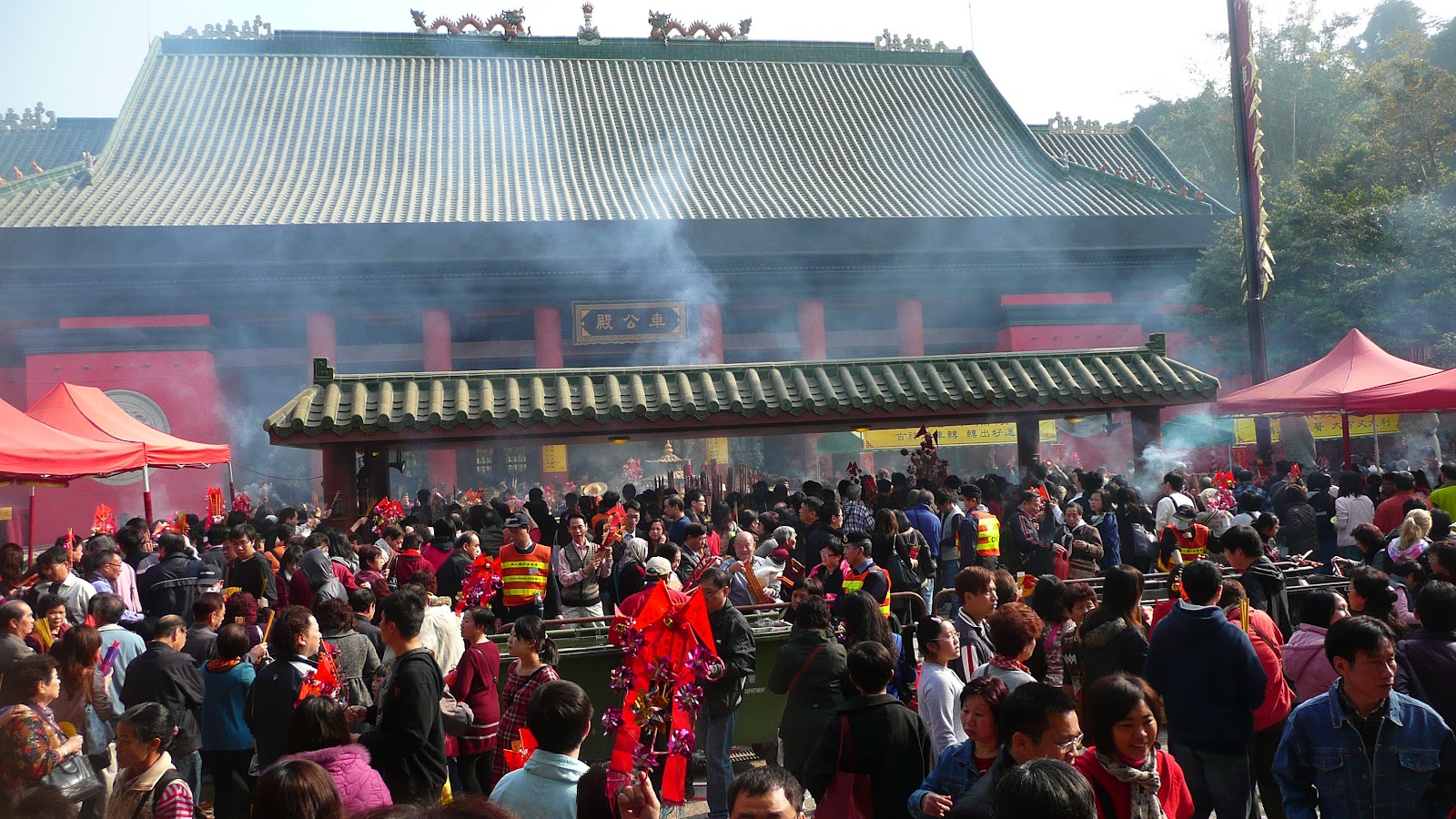
Che Kung Temple (車公廟) is a fairly well-known place in Hong Kong, though it probably won't be in the general populace's everyday consciousness until Lunar New Year hits the city. Which makes it the perfect place to visit on any day of the week, though I personally find the temple to be worth visiting under a festive atmosphere and whilst jostling with the crowds (this not applicable to shopping mall trips.) The crowds visit during the second and third day of every Lunar New Year, depending on when one is done making the New Year rounds of visiting relatives.

The inside of the Che Kung Temple during the New Year. This is not the original structure, but an installment from the 1990s. This photo is from the third day of the Lunar New Year in 2011, this isn't even the peak visiting hour. Normally, from 11am onwards, the police have to cordon off the entrance to let visitors into the temple in batches.

A lot of the background information about Che Kung Temple can be found on the HK tourism website (and even on Wikipedia), so there isn't any point in repeating what is said elsewhere. But while these accounts note that the temple was built to commemorate the General Che Kung, there is also a lesser-mentioned narrative about the temple being built as thanks for Che Kung's help with fending off a plague that hit the Sha Tin Valley region centuries ago, thus providing a physical structure where this appreciation can continue to be displayed even today.

The cynic in me isn't sure whether current visitors are paying their respects to Che Kung, or just praying for better luck in the new year (one being an act of devotion, the other being a bit more orientated towards self-interest), but I suppose the line dividing these two practices is thin, and perhaps arbitrary. Devotion and self-interest are interrelated, especially in the context of spiritual beliefs in today's Hong Kong, which has never been fully articulated or defined (people I've talked to can't even say whether they feel it is superstition or religion, and they don't seem inclined to care for these terms.) Either way, short of wishing to bring harm to others, there really is no wrong reason an individual can have for visiting Che Kung Temple.

Stalls inside and outside Che Kung Temple telling pinwheels to visitors, so that they can 'spin for luck' inside their own homes. (Note; the blue bucket is an old fashioned way vendors used to stash their money. The bucket is attached to an elastic rope and pulled down when in use. Its public placement is deliberate, so that they and other vendors can help keep an eye on it too. You can still see this being done in the public markets.)

Politicians 'representing Hong Kong' visit during the New Year period to 'Kau Chim' (求簽), to literally 'ask for a sign' that indicates the upcoming fortune of Hong Kong. How these politicians think they have the right to represent the entire city is beyond me, though this is a topic to be saved for another day. Funnily enough, the 'sign' received this year has been described as pretty average (meaning; bad, but the media and politicians probably didn't want to paint it that way lest it dampens the city's morale); to which the Hong Kong population can attest to that being fairly accurate. It is only March, but whether it is the political or economic situation, the reaction from a lot of people would be a frustrated 'meh'/'bah!'

The inside of the temple is lined with giant pinmills. Regardless of the meaning these pinmills may have, anyone can appreciate the splashes of vibrant colour they offer for visitors.


Fortune-telling is a service offered at Che Kung Temple, but the main attractions during a New Year temple visit would be the 'wheel-spinning' (a metal fan with blunt edges where you can 'spin for better luck'), and the drum-beating (the loud noise will hopefully wake up Che Kung so that he could hear your wishes.) The queues for both activities are pretty long, but if you're going to make the journey there, you might as well try it out.

A quick note: for those with breathing problems, and those who do not enjoy the smell of incense and smoke, it might be wise to visit on a not-so-festive day. The amount of incense being burned during the New Year can be fairly intense, to the extent where Temple workers themselves wear medical and industrial face masks to protect themselves.

Incense burning is common on festive days, hence some temple workers brandish huge fans hoping to disperse the smoke and to help with air circulation. These are not scented incense, so do not expect floral scents to whiff around in the air.

And then there are the pinwheels. Some of these pinwheels could be better described as windmills, seeing how their sizes can range from keychain-sized to over a meter high. Pinmills styles have small variations every year; in 2011 they sold ones with little birds in the middle of a 'pinwheel cage', and in 2012 the 'pinwheel ball' was more predominant. Different pinwheels will have different wishes written onto their accompanying placards (ranging from academic performance, health status, love life, career progress, personal safety, and many others.) For those with shifty Chinese-reading skills (like yours truly), you can simply ask the vendor to find the one you want.

Pinwheels are not expensive, and bartering is an option (especially for multiple purchases.) My mother and I each bought a medium-sized pinmill this year, which brought the total cost to 45HKD. My mother bartered and asked the vendor to lower it to 42HKD, to which the vendor told us off for choosing an 'unlucky number' (the number '42' in Cantonese sounds like the word for 'death') and asked us to pay 38HKD instead.


So the last issue remains; how does one get to the Che Kung Temple? With this being Hong Kong, where old structures are never too far away from the comforts of 'urban modernity', the MTR has a Che Kung Temple Station on the Wu Kai Sha Line which should take you directly to the proximity of the temple. But here is a tip: is better to get off at Tai Wai Station and just walk there. It is less than 200 meters away from the stop, the route is well sign-posted, and it saves you the extra train fare. Plus, if you want to grab a bite before heading to the temple, Tai Wai does offer a lot of food joints.