Monday, 4 June 2012

Event: 這一代的六四

For the older generations in Hong Kong who witnessed June 4th 1989 through real-time feed from the media, it leaves an emotive memory even twenty three years later. But for the younger generations, such as those born in the 1970s, 1980s, and 1990s, what does June 4th mean for them? Children of these three decades were too young-- and perhaps not even born yet-- to have had the emotional and memory capacity to remember and feel the implications of 1989.


only learning about it through oral narratives from older family members, the calls from democratic political parties (don't be fooled by the Democratic Alliance for the Betterment of Hong Kong, the DAB, despite them having the word 'Democratic' in their name. They are incredibly pro-Beijing, and in 2007 their ex-chairman Ma Lik tried to play down the killings that took place in Tiananmen), the media, and from the internet. Unlike in mainland China, the term '六四' (Chinese for June 4th) is not taboo, nor risky to use in the face of authorities; one could say that the current youths grew up alongside this term, and thus June 4th is cemented within the youth psyche. 

But what exactly does June 4th mean for youths? Without bearing direct witness and only relying on secondary sources, can the meanings from 1989 transcend into the present day? Or is it even important to keep the same meaning from the past; can the youths of today's Hong Kong create their own connection towards June 4th? (And is it enough to just be aware of the killings, and not to engage with it?)

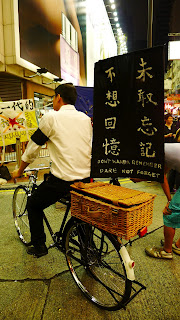
This is what some Hong Kong youths try to address; one such effort manifests as an art performance on the streets of Causeway Bay, known as 這一代的六四. (Having to use the phrase 'art performance' as a way of describing it shows the limitations of the English language. The word 'performance' denotes a show meant for an audience, and contains a degree of entertainment value. The Chinese phrase used is '街頭藝術活動' which can be roughly translated to 'action of art' on the streets.) This is its third year in the running, where a group of youths (and some non-youths with a youthful spirit) with and without art training will stand on the street for two hours expressing their views and understanding of June 4th. There are a range of different art practices at play; performative art, contemporary dance, choir song, poetry reading, and paintings placed on the roadside for view. 

Some displays leaned towards the literal (harkening to the imagery of the Tiananmen tanks), others more abstract. Some worked together in groups, others alone. Some appeared to be a commentary on the killings and repression of 1989, others touching upon a more personal narrative. Some spoke of Beijing, others transcended the matter of site and focused on the practices of the Hong Kong mentality. Check out some photos:


People who encountered this performance may not necessarily understand or interpret what is going on (nor will I profess to have encompassing insight about all of it either), but then it seems superficial to assume that the various happenings of the night is only devoted to the entertainment or gratification of the passing public. (And so leads to a much bigger issue of about the nature of art itself, and the state of art education in Hong Kong...topics that I'm nowhere near qualified to ramble on about.) 


The street performance shouldn't be construed as a separate way of remembering June 4th, breaking away from the annual candlelight vigil at Victoria Park organized by formalized organizations, institutions, and political parties; many of the performers will also take part in that as well (this art event took place on the 3rd of June, so that there will be no clashes.) You could call it a supplement to the more 'mainstream' ways of remembering 1989, allowing a new avenue to explore and interact with this bit of unresolved history. 


Sunday, 3 June 2012

People: Mr. Henry Wong

Given how antisocial I tend to be, I'm not sure if there will be many more posts under this 'people' heading. But that doesn't mean there are plenty of interesting individuals out in Hong Kong to meet. One of them would be Mr. Henry Wong, who also signs his work as 本地薑 (translates roughly as 'Local Ginger'.) 


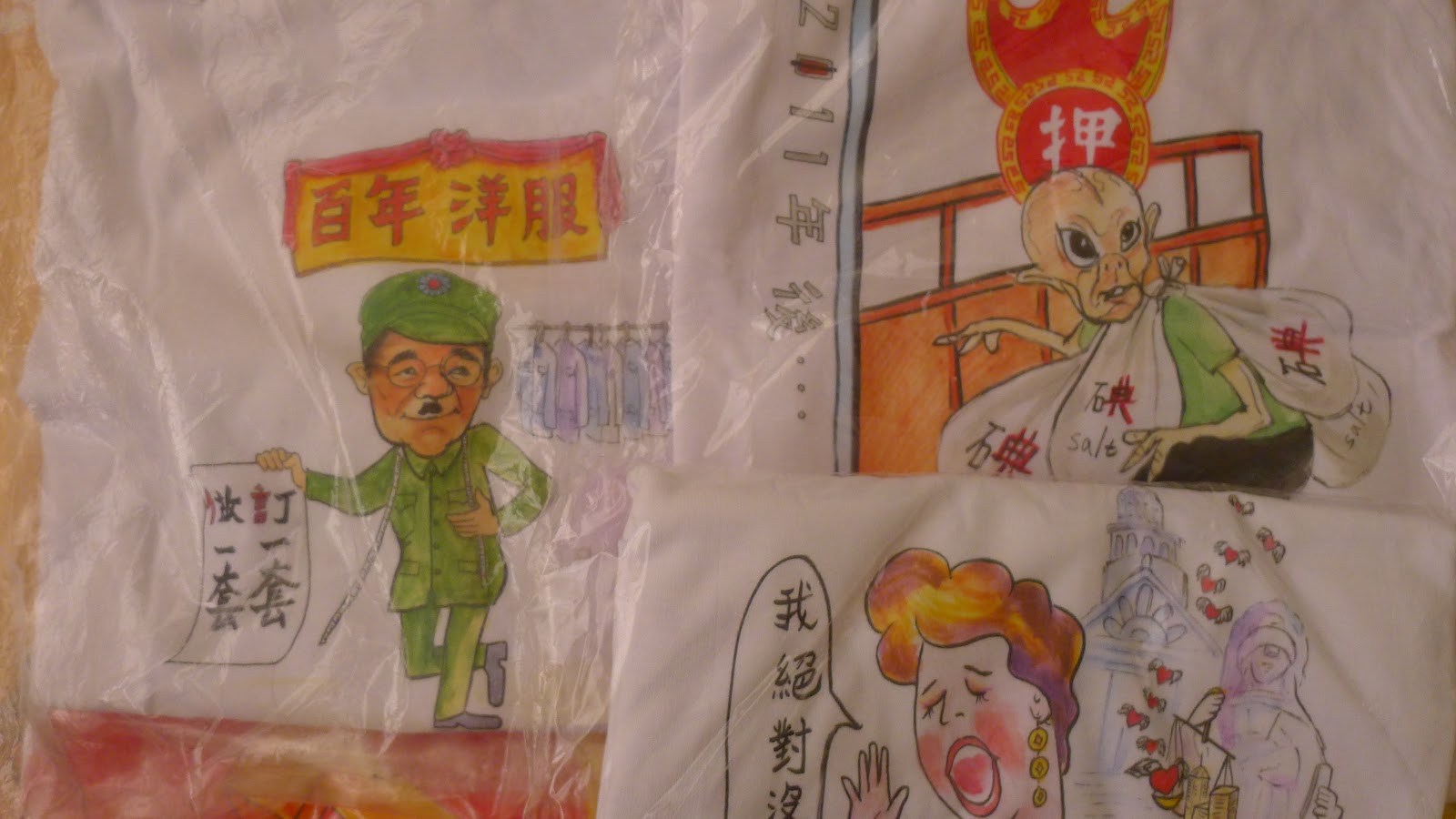
I met him by chance back in May 2011, during a random visit to Wooferten in Yau Ma Tei, and encountered him during protests and other events around the city. He is a good representative of the mindset for many Hong Kong people; maintaining a day job but also yearning to find an outlet to express their political viewpoints. Mr. Wong chose to fulfil the latter need by creating witty and humourous t-shirts.


Each shirt is produced in limited numbers, and is specific to the happenings in Hong Kong at a given time. For example, there was a shirt for the salt-buying-scare during the Fukushima radiation leak in March 2011, and another covering the Chief Executive elections this March and April. The images aren't abstract, nor are they literal; it requires the use of brain cells to interpret the layers of meaning and Chinese wordplay. (Which is a difficult for me, since my Cantonese is bad enough on the surface level without even delving into the world of Chinese puns.) If one ever have the fortune to encounter Mr. Wong, he'll be more than happy give a step-by-step explanation to anyone who is interested. Though he would prefer if one took a stab and attempted to interpret it first; and one should do so, since we already live in a culture where images give us instant gratification. Being made to think for ourselves is a refreshing reversion to the pre-mass media and pre-advertising image proliferation days....


Mr. Wong will attend certain protests and events where he sells his shirts. There isn't a fixed price on them, since profit and money isn't his motivation. During the last encounter, he told a small group of youths that he spent roughly 40,000 HKD on this endeavour already, and will continue to do so because it is his 'hobby' and something he is truly passionate for. And he is sincere about his lack of emphasis on money; in my experience, he has never pestered anyone with immediate payment. (Though it doesn't mean he is flippant about money either; I gave him 20 HKD ages ago, and he still remembers-- even though I had forgotten-- and gave me some of his shirts this April. It is nice to know that there are still people in such an urban and mechanical city that can bring 'trust' into their interactions with others.) 


It is worth mentioning that the imagery is all drawn by Mr. Wong, who has had no formal training in the arts or with illustration. Which shows that no matter who one is, or what background one has had, does nothing to thwart the ability to contribute towards the city's diverse array of political voices. 

Thursday, 10 May 2012

Read: 推土機前種花


Yesterday was hot, yesterday was full of sunshine, yesterday was a sweat-fest. And finding myself in the area of Yau Ma Tei didn't help (urban heat island effect! Geography 101.) Thankfully Kubrick was nearby, providing air-con, a cafe with plenty of nice beverages, and a bookshop. Needless to say, where there are books, my wallet opens. 


So say hello to 推土機前種花 by 周綺薇 (Maggie Chow.) The book revolves around the neighbourhood of Sham Shui Po, with the introduction taking the reader back to a 2007 meeting at the Sham Shui Po District Council between government representatives and the residents affected by a 2004 government initiative to redevelop the area. The meeting degenerated into confrontation when the government accused the residents of 'illegally using government property'. Further exchanges between government workers and the affected locals resulted with the questions of the latter being met with obtuse non-answers and threats of police action from the former. Nothing shockingly novel about that scenario, since it is a widespread problem in current Hong Kong and is often reported in the media. 

But by introducing Sham Shui Po to the reader through the context of a conflict allows us to see that it is precisely these conflicts that emphasize, and render visible, the strong community ties that exist. The structure of the book is divided into six sections titled; the district and I; following the path of the neighbourhood locals; telling our story; love letter to the community; the flower gives fruit, the flattened land; and Postscript. 

The first section examines the nature of a neighbourhood, and the author makes such a narrative coherent by weaving her own background and experiences into the text. Instead of presenting her Sham Shui Po neighbours as 'faceless entities', she includes the names and backgrounds of those in her building, and show the linkages between them. By 'linkages', it refers to how they are situated within the physical space (e.g. Old Man 雷 lives in the flat under Uncle 李, Old Man and Old Lady 高 lives upstairs from the author on the fourth floor, etc.); or their role in the community (e.g. Old Man 雷 uses his medical training from his youth to give advice to neighbours, Mr. and Mrs. 馮 run a stationary shop that serves as a centre for news to spread around the locals, Limbu is from Nepal and runs a little corner store.) The best thing about these character introductions is that they are highly personalized, containing the little mundane details that are important to the author herself. 

The other sections takes the reader away from the seeming timelessness of the author's immediate social surroundings, and back to the the problematic world outside. The text then provides a chronological description of the major events that happened, detailing the neighbourhood's progression from voicing their ideas out in public, refusing to play the role of the victims, envisioning their ideal Sham Shui Po through the help of a Dutch activist by the name of Elena, and more. The book does a good job documenting the different events and discussions that take place at different moments in time. One event of particular interest would be the 2007 'Story Telling Gala' on Hing Wah Street, where the author helped erect huge posters formatted to look like the shop fronts of local business owners. People were allowed to interact with the store keepers depicted in the posters, and to leave write comments to stick onto the images. Another event infused with humour includes creating a series of worksheets for Carrie Lam Cheng Yuet-ngor (Permanent Secretary for Housing, Planning, and Lands in 2003/2004 and later the Secretary for Development) including lessons asking Lam to think about what it means for the government development office to put 'people' first (and who these 'people' are interpreted to be), what directions development should take, and the way of life in Hong Kong. 

Ultimately, the efforts of the residents did not stop the Urban Renewal Authorities from tearing down the affected areas, displacing the community and severing the complex network of ties that were there. But the author concludes the book on an optimistic note, as from this episode there sprang a new empowering consciousness within the local population, manifesting as The Sham Shui Po Renewal Concern Group. I for one, am curious to know 'what is next?' and to see what sort of strategies the Group will employ in the face of future government development.      Other questions include; what does the author see as 'ideal development'? In the author's view, what is the degree of effectiveness in the strategies used? And while there are lessons learnt by the local residents, what can the government take away from all of this? How does development practices in Hong Kong compare to those abroad, and is there a model from abroad to learn and copy from? The book manages to force the reader to look with a critical eye at the term '活化' , and to rethink what 'urban renewal' really means (to replace or to rejuvenate?) 

On an unrelated note, is it hard not to notice the plethora of lovely illustrations and photographs in the book, rendering it almost into a graphic novel. 

Book retails for 110HKD at Kubrick (99HKD for Kubrick members). It is 148 pages long, published by MCMM Creations in 2011. Mostly written in Chinese, with a few pages of English translation in the back (though I must say that the English does not fully cover everything mentioned in the Chinese sections.) 

Sunday, 6 May 2012

Weekend: Yau Ma Tei (through Wooferten's Mobile Bar Battle)


Yau Ma Tei was originally a village, though the exact meaning of the name 'Yau Ma Tei', and the industry the name harkens from, is unknown. (Funnily enough, the MTR tried to name the station there as 'Waterloo', after Waterloo Road, when it first opened in the 1970s.) Urbanization made it almost unrecognisable from its historical image; it once had its own bay and beach, and now it is a part of a densely populated hub quite a ways from the water. You can tell how the coastline has shifted thanks to the aptly named Reclamation Street to the west. Following Wooferten during one of their weekend events was a good way to catch a glimpse of just how fascinating the area is. 

Wooferten (浩化廳) is one of my favourite places, calling itself as a community art space, something that is rather lacking in this city. And they do take 'community' seriously, welcoming neighbours to gather and sit in their space on Shanghai Street, and initiating outreach events to bring people together. 


Last weekend, Wooferten (alongside 素人之亂 from Japan, and with the help of Mr. J) hosted the Mobile Bar Battle , with the slogan of 'Hong Kong Never Drunk'. The purpose was to hand out free alcohol to the locals in the area, but instead of making them come to the art space to get it, the alcohol was brought to them. The event featured the locally-brewed Yau Ma Tei beer (see previous post), also providing a fair share of store-bought canned-beer, and miscellany alcohol that Mobile Bar Battle participants brought. As the visiting Japanese activist at Wooferten said, alcohol is a social lubricant, bringing people together. And true to his word, the turnout was awesome. 


Some photos to share: 
Wooferten at 404 Shanghai Street, just before setting out for the neighbourhood. It was hot, it was very sunny, it was sweat-inducing. But it was well worth going

Waving banners, pushing trolleys and carts of beer around. The planned route took us through a couple of blocks in the area

So adorable! But never fear, no minors were given alcohol. This little girl contented herself with Vita brand lemon tea and some roast pork from the cart

Walking past the corner houses (more details about these in a previous post) that are so common in the area. The great thing is that you can still see how 'lived-in' these buildings are

Couldn't resist photographing this wonderfully illustrated bag (reads 'this city is dying'), especially since it echoes the current sentiments of many young people in HK. 

Sharing the roast pork around. Couldn't grab a piece, since the young'uns and the elderly were given first dibs

Heading down the wet foods market on Nelson Street

Pouring alcohol to anyone (over 18!) who wanted it 

Cheers, matey! 

Ending the Mobile Bar Battle route at this local park. Live music, casual chats, a jovial atmosphere all around

Credit goes to Wooferten for their effort in providing the goods used in the Mobile Bar Battle
Overall, the event was well-received by people in the locality. There was the occasional person who overtly comments on how the Mobile Bar Battle group was 'being pointless' and 'doing something rubbish', but who cares? Local stall owners waved and sampled the alcohol, people in windows waved, and a lot of people were smiling as the group walked by. Patrolling policemen jokingly said they might try some when their shift ends. And the fun wasn't only experienced by the people we encountered, but the Mobile Bar Battle was also fun for those of us who tagged along. 

Tuesday, 1 May 2012

Musings: Alcohol

It isn't fair to say that this is my musing, since most of the content of this post came from a conversation with Joshua (better known as Mr.J, check out his facebook misterjishere), a Hong Kong-based performing artist with a serious interest in brewing alcohol. I chatted briefly with him during an event jointly held by him and Wooferten last Sunday, where participants roamed the neighbourhood handing out free alcohol to all sorts of people, which will  be discussed with more depth in the next post. Here the focus will be the musings about alcohol itself, so now, thinking caps and beer goggles on! 

The brewing maestro
Together with Wooferten, Mr. J created a batch of beer that can truly be called 'local'. Brewed locally, using local ingredients. For example, the process of fermenting alcohol requires sugar, but rather than use the boxes of powdery snow-like sweetener you see in the supermarkets and coffee shops, peen tong (aka brown candy that comes in slabs) was used instead. It isn't commonly known that the use of peen tong in the kitchen is confined more or less to the Southern Chinese provinces, Hong Kong included. These small details are a big deal, affecting the overall taste of the product.

And most people were surprised to learn that it was possible to brew alcohol right in the middle of a densely populated, space-sparse, and aging neighbourhood of Yau Ma Tei. If one is brewing as a hobby, and the product is intended for self-consumption, the amount you can brew inside the tiny flats of this city* is limited to how big of a bottle you can find to contain it all (based on what I've seen on Sunday, it looks as though the 4.5 litre distilled water bottles were the most popular.) The fermenting process can take as long as you like; Mr. J would let a brew sit for two weeks, though Wooferten managed to produce a batch in a week and a half. The Wooferten mixture was a little murky to look at, but based on the reaction of those who sampled it, the flavour was nice, and the alcohol wasn't too strong (a plus or a minus, depending on who you are.) 

And viola! The product that made its public debut last Sunday, coming in three flavours ranging from oolong and mint to something akin to lemon tea. The label reads as 'Yau Ma Tei beer', with a design from Wooferten that harkens to the good ol' days in Hong Kong history (though someone jokingly said it looks like a bottle of medicine instead of a beverage... ) Classy and humorous 
If one is asking why there is such an emphasis on 'local', maybe it is better to ask why we don't seek locally-made products instead of relying on imports? Asahi is from Japan, Tsingtao is from mainland China, Corona Extra is imported from Mexico, Heineken is from Amsterdam. Sure, Hong Kong has its own breweries for brands like San Miguel, and the production of Blue Girl in South Korea is monitored by a Hong Kong corporation, but the former is partly owned by overseas stakeholders and the latter retains its German roots through its formula and the brewing process. Both beers aren't even marketed as local; with the San Miguel commercial playing up its European appeal, and Blue Girl featuring a bunch of foreign youths climbing up a tree in a tropical rainforest trying to photograph multicoloured birds. So is there an alcohol that can be seen as representing Hong Kong? And what sort of traits will it have to distinguish it from other alcohol across the globe? It was a challenge undertaken by Wooferten and Mr. J this past Sunday, and I think while this effort is still nascent, it is a good showing. 


The 'localness' of a beer ignites a few musings, but getting involved in the production of beer itself leads to other tangents of thought. Mr. J evoked questions of what alcohol really is, and what meaning lies behind the terminological divisions between wine, beer, ales, etc.; a rather philosophical vein of inquiry. As for me, the production of individualistic and unique alcohol relates to a concern resonating throughout current Hong Kong society; specifically the lack of consumption choices presented to the population. Most of what is ingested comes from large corporations, notably the titans of Wellcome and Park'n'Shop that overshadow and oust the smaller grocers. We've become accustomed to being provided for by these retail chains that we've forgotten the actions of making, and are instead transformed into creatures whose only action is to open our wallets and hand our money over to a cashier. Our role in the production of our own foodstuff is greatly diminished in this city, and while I'm not saying that everyone should immediately run out of their office habitat and start ploughing the land, we shouldn't completely discard the agricultural past and knowledge in favour of everyday conveniences. So be it a hobby or a profession, growing peas in a pot or brewing alcohol in a bottle, any means of re-establishing or maintaining a direct link to the land (and our stomachs) is appreciated.


Hm, who knew that a post revolving around alcohol can result with all this text? 


*Before any alarm bells ring regarding the legality of home-brewing, the government states that no license is required provided  the brewer is of age (18 in this city) and that none of it is sold. One is also limited to a maximum of  50 litres of home-brew, but it is doubtful that this quota can be reached by most people. 


----------------------------------------
Read more: 


-Government legislation page pertaining to home brews
-New York Times article on Local Brews (though granted, this was written back in 2009, and given the high turnover rates in Hong Kong, who knows if any of the listed establishments remain today?) 

Thursday, 19 April 2012

Musings: The ID Card


For long-time Hongkongers* above the age of 11, having an I.D. card is a part of life. One can obtain it through being born in this city, by parentage, or by residing here for 7 years. The full details of this is listed on the government webpage, though even with all their fancy wording, the defining parameters for who exactly constitutes a permanent Hong Kong resident is still a mess. There is a lot of controversy regarding these criteria, and rather than delve into those matters (one can hear about it in the news, which consists of emotive and sensationalized statements from both sides of the argument. And given what C.Y. Leung, the Chief Exec-elect is saying in his press statements, the first criteria looks as though it will be challenged.) I'm more interested in considering the nature of an I.D. card itself.

For starters, the card is a means to identify ourselves, to delineate our individual statuses in this populous society. Many parts of our social lives depend on it; from the overt purposes of voting, seeking employment, attaining medical care, or having a bank account; to the more discreet need for an I.D. number to apply for memberships in clubs, getting a phone subscription, and whatnot. My I.D. number was needed for bike rentals (see post about cycling to Tai Mei Tuk.) With the card having such a wide range of applications in our daily lives, it is possible that a phenomenon called 'function creep' has come into play. The most basic meaning of 'function creep' is where some form of item gradually infiltrates our daily lives to fulfil different domains of needs. We become over-reliant on this item, treating it akin to a limb. 

While these cards fulfil our personal daily needs, it also serves the needs of the governing body. It might seem as though having this I.D. card benefits the holder by allowing them to glide through Hong Kong immigration controls with ease (and who hasn't done this while smugly looking at the immigration queues for visitors), but it also helps the government departments keep track of who is going where and when. The holder can apply for welfare with the card, but it also lets the governing body know what you are up to, and what your finances are like.  I.D. cards facilitate the surveillance needs of a governing body. Surveillance often has negative connotations within the media and common imagination, but can have positive applications especially in the context of crime. The reason why the positive is often overshadowed by the negative is because surveillance technology is easily abused, or has the potential to be abused, by the people who employ it. Surveillance is a huge topic of discussion and broaches on many social issues, especially in helping the formation of a 'police state', invasion of personal privacy, and the erosion of civil liberties, just to name a few...


(And just wondering; do we ever question why police seemingly pulls people aside on the streets for an I.D. check? What sort of criteria do they use to select these people?)

These identity documents can also be socially segregating, denoting different degrees of rights received by segments of the population. Having a card confers certain rights to the holder, allowing access to medical, education, welfare, and other government-provided benefits. But at the same time, it also denies certain rights to those residing and working in the city without a permanent I.D. card. I'm specifically referring to the different identity documents held by Filipino domestic helpers, emphasizing their temporary statuses in Hong Kong, that can lead to differential (dare I say, discriminatory?) treatment towards them by the government and by the wider population. (On another tangent, do check out the 2011 Filipino residency bid in Hong Kong. It touches upon just whom the Hong Kong government wants to give a permanent I.D. card to, alluding to notions of 'desirable' and 'undesirable' citizens. Google 'Vallejos v. Commissioner of Registration'.) 

But if we are going to criticize the I.D. card, why shouldn't we extend the same points towards the Octopus card? The only difference between the I.D. card and the Octopus is that one is explicitly stated as being mandatory by the government, the other advertised by a corporation as a convenience for our daily lives. (And like the I.D. card conferring rights to its holder and denying it to those without, those with Octopus cards also pay a little less for their train fares in comparison to those who buy tickets for each individual trip.) We don't perceive the same qualms with Octopus cards which exhibit the same 'function creep' traits as the I.D. card. The Octopus was first introduced for use on all modes of transportation, and is now a mode of payment for supermarkets, fast-food restaurants, convenience stores, and other retail services. The amount of personal information submitted to obtain an Octopus card transformed it into something of a secondary I.D. document (check out the 2010 Ming Pao article for more details.) The personalized Octopus knows your I.D. card number, your bank account details (for automatic refill when credit is low on the card), and all of your contact details. 


With all that personal data floating around the information banks of a single corporation, just how can we guarantee that it is treated in a suitable manner? The 2010 article from Techwire mentions how personal information of some Octopus users were sold to other business groups, for the sake of profit. It is worrying that despite an apology being issued by the Octopus group, and that this transaction of personal data did not result with any major consequence asides from an irritating ad here and there, this giant ethical question mark remains unresolved. But what is even more worrying is that the Hong Kong population did not display any large outcry from this abuse of trust, and simply got on with everyday life. 


And, if the Octopus card can abuse personal information for its own benefit, how could we be sure that personal information from our I.D. cards won't be/hasn't been used for the interest of a select few? 

There is a bundle of unanswered questions in my head. Why is an I.D. card mandatory for Hong Kong, when there are other countries that do not use it, or just makes obtaining it an optional endeavor? (For example, I chose to get an I.D. card from the California DMV because I needed to prove I was over 21 to enter Dave and Buster's for a social night. Noble, so noble.) Other countries such as the UK and Australia don't require I.D. cards at all, have clear reluctance towards implementing an obvious national identification system, and yet manage to harbour functioning societies that do not delve into chaos and anarchy. Why do we need to carry these I.D. cards with us all the time, and why must we present them to government bodies on the streets if requested? 

I think this entire rant was derived from my finding I.D. cards to be rather strange. My concerns are not only based on privacy issues (well, seeing how I have facebook, twitter, and a blog. And growing up in a city filled with CCTVs tends to desensitize one from such matters), but more to do with people in this city becoming accustomed towards having our entire lives being compressed into a series of numbers and data fragments on a microchip. It is indeed a unique sensation to have one's entire being and self being summed up by a material item a fraction of our physical weight. I'm neither against or for having an I.D. card, seeing how I grew up within this reality of enumerating my personal bio (heck, even the Chinese characters of my name are coded, which is awfully Borg-like), but it is important to ask questions... 


[This post will continuously be updated.]

*one of my postgraduate friends in the UK, upon hearing that I was from Hong Kong, jokingly referred to me as a 'Honkie'. Politely put, this is NOT the preferred term to use. Because it is unknown if my friend used the word with its associated negative connotations (it is often the case that people who make such gaffs are those who do not thoroughly examine the meaning of words), it wasn't worth getting offended or angry. 


It should also be said that whom term 'Hong Konger' encompasses is not very well defined. I've been asking around, but no one can give me a direct answer. Based on what I've seen and heard, there seems to be a  combination of linguistic, residency, ethnic, education, I.D. card, and birth-place component at play...
-----------------------------------

For more information on this topic:

-Greenleaf, G. (2012). 'Hong Kong's 'Smart' Id Card: Designed to be Out of Control'. in Bennet, C. and D. Lyon (eds.) 'Playing the Identity Card', Routledge (Online version as PDF file.) (This author also has other articles pertaining to the Australian response towards a national identification system, a good read.) 
-Lyon, David. (2008). 'Surveillance Society'. Talk for the Festival del Diritto, Piacenza, Italia. (Online version as PDF file.)  

Tuesday, 17 April 2012

Weekend: Cycling, Tai Wai to Tai Mei Tuk


People are getting really into the cycling lifestyle, and I'm not referring to those ah-baks cycling around in the middle of the city delivering take-out food or giant canisters of gas. Cycling is a growing movement in the city, manifesting through cycling-devoted groups (ranging from government-sponsored bodies dedicated to cycle racing, mountain bike enthusiasts, and an NGO seeking to raise awareness towards the concerns of HK cyclists. For the latter, check out the Hong Kong Cycling Alliance website and facebook. They offer comprehensive info on carrying your bikes on public transport, safety tips, and more.) If you live in the New Territories like I do, you'll see die-hard cyclists in their lycra cycling outfits pedalling around on their racing bikes every evening. (There is also the amusing sight of lycra-wearing cyclists...on a tiny urban fold-up bike.) But for most people, the sport itself is a weekend activity for socializing. 

My friend and I chose to do the Tai Wai to Tai Mei Tuk route on a Saturday, which has been covered by CNN.go and HK Magazine. It is one of the most popular cycling routes (removed from traffic for the most part, is well-paved, and signposted**) in Hong Kong, offering paths through some of the nicest scenery. The routes are well paved, and are generally wide and spacious. (Because of the construction near the site of Providence Bay after passing the Science Park, there are barriers erected on the left side of the cycle path. It doesn't obstruct the path itself, but many cyclists bottleneck themselves along this stretch because they all swerve to the middle to avoid colliding with the wall.) 


The signposting is fairly consistent throughout the first leg of the journey, though it seems to be sparse upon reaching Tai Po. There was no sign pointing towards Tai Mei Tuk when we reached a fork after exiting a subway tunnel, and we had to ask another cyclist for directions. As a marker, if you pass by the Tai Po Industrial Estate on your right side, you are heading in the right direction. 

While the bike route is mostly self-contained (not having to share it with pedestrians or cars), there are certain sections where you will intersect with a pedestrian pavement or traffic crossing. In the latter case, even if it seems as though there is no car approaching, just wait until it is your light to cross. Cars have that uncanny ability to suddenly show up when least expected, and safety should always come first. As some would say, a car is 鐵包人 (person encased in iron), whereas a cycle is just 人包鐵 (iron encased by a person.) Upon impact, it isn't hard to guess who would come out with fewer injuries. 

The cycle shop we rented our bikes from in Tai Wai. We went with this one one because it was situated very close to the East Rail station, though you can ask locals for cycle shop recommendations if you need to. 

We were charged 80HKD/each for bike rentals, and that is for the entire day ('day' being defined as until daylight fades: returns must be made by 7pm.) I'm sure we got suckered since both my friend and I look like out-of-towners, but it wasn't an outrageous price so we went along with it. In regards with bike returns, most shops will have a drop-off point in Tai Mei Tuk (though if you choose to bring the bike back to Tai Wai, you might earn a bit of a refund with the bike rental fee, around 10HKD in this case), but you should ask explicitly where they are in Tai Mei Tuk. We learnt this the hard way; the drop-off point for this bike rental shop was actually a 5 minute bike ride (15 minute walk) outside of Tai Mei Tuk, on a small village road full of cargo containers. It took some luck to even spot the shop banner hanging from the mesh fence. It looked like something straight from the deserted streets of downtown Los Angeles.  

Do check the bike before leaving the shop, making sure the wheels are inflated, the front and back brakes are functional, the grips aren't worn down, and the height of the bike seat is appropriate (normally, I prefer the seat to be high enough so that my toe barely touches the ground when I'm standing straight. If the seat is any lower than that, my knees hurt during cycling because they are forced to bend too far.) Have the shop adjust these things for you, and don't be scared to ask for a different bike if you are not satisfied with the one provided by the shop staff. And if the cycle plan intends for stops at several locations for rest or sightseeing, ask about bike-lock rentals as well (or just bring your own.) 


The cycle path travels alongTolo Harbour, so there will be plenty of sights like this. This photo was taken a little off the cycle path (less than a minute away from it) just before entering Tai Po. 

No bike lock for us, so we were always keeping an eye out on our rides. It is worth stopping at Plover Cove for a bit of a sit and a think. There are some hipster-types by themselves, sitting on the rocks, looking into the distance, and writing in their Moleskin notebooks. It is a good place to contemplate the meaning of life, and have a bit of private angst...at least before the crowds arrive.  
Sitting at Plover Cove Reservoir. With such nice scenery, we brought our own snacks and lunched outdoors. (If anyone else plans to do so, please don't leave any rubbish behind.)  

The road at Plover Cover Reservoir. It isn't strictly a cycle path, but park authorities driving in their van are fairly patient (didn't even use their klaxon once) and will give cyclists time to move aside for them. But beware of the pedestrians along this stretch, and also at either end of the roundabouts! There are plenty of people who come up here to fly kites, and their kite strings can entangle an unwary cyclist.

View from the reservoir, people enjoying the watersports facility in Tai Mei Tuk. Windsurfing is another big thing in the Hong Kong sports mindset.  

Tai Mei Tuk is a great destination for cyclists, thanks to its scenery and its good selection of restaurants and places for refreshments. However, because the location has been on the tourist radar for quite some time, the prices and food venues have 'upgraded' itself. (Though it was good to see that the Thai restaurant I went to back in 2006 was still pretty much the same.)  If the price range of an indoor eatery is a little over one's budget, head to the waterfront area and there will be some cheaper outdoor eats, such as curry fishballs and noodles. Alternatively, if you are willing to lug a bag of coal, raw foods, and other BBQ equipment on your bike, Tai Mei Tuk has plenty of BBQ hearths for public use.  


Since a large part of Tai Mei Tuk is devoted for BBQ-ing visitors, so prepare for a lot of smoke and noise near these sites. There are quiet spots away from the Tai Mei Tuk crowds, such as this little bit of coast. There isn't any 'official' access to this stretch of rocky shore, but someone did gouge an earthy path from the road that leads to it. There were only several other people there picking up shells. 

If you return your bike in Tai Mei Tuk, you can catch the 75K bus at the bus terminus (close to the big BBQ site) back to Tai Po Market station, which will link you up with the rest of the MTR system. 

Note: If you are not sports-inclined, I would recommend cycling up to Tai Po, since the entire length of the route from Tai Wai to Tai Mei Tuk can reach around 20km. It might not sound like a great distance, but under the sun and wind, it adds up to quite a bit of physical exertion. There is a great Waterfront Park in Tai Po to explore, not to mention that Tai Po is interesting in itself. 

-------------------------------------
Tips:

Tip 1: Start your journey early to avoid the post-lunch afternoon rush! We started around 10am, and arrived in Tai Mei Tuk a little before 1pm. By the time we left the area at 4pm, the crowds were starting to cycle in by the dozen...including those cyclists with the loud boombox (literally a boombox, not just any music player) strapped to the back of their bikes. They would make for an interesting anthropological study...the culture of boomboxing bikes. 

Tip 2: If you are cycling on the weekends, keep an eye out on the cycle path. Like the phenomenon of 'weekend drivers', those who only take their cars out for a spin on the weekends, there is such a thing as 'weekend cyclists'. They tend to be a bit unpredictable with their turns, and are prone to braking suddenly, so it would be ideal to overtake them when you can. (Unless said 'weekend cyclist' is your mate, in which case, there isn't much you can do short of making new friends.)

Tip 3: If you can't cycle uphill, walk it. There is no shame in doing so! Better be safe, than to struggle on your bike and zig-zag into someone else. (Notable uphill stretches; the subway tunnels near the Science Park; the road just before entering Tai Mei Tuk; and the path to Plover Cove Reservoir.) 

Tip 4: Some bike rental shops will require identification documents as a means of guarantee when renting their wares. Bring your ID card/passport with you. 


------------------------------------------------

** post edited due to the comment from Dennis (see below)